
Panama: Aftershocks, Uncertainty, and Thousands Affected After Earthquake
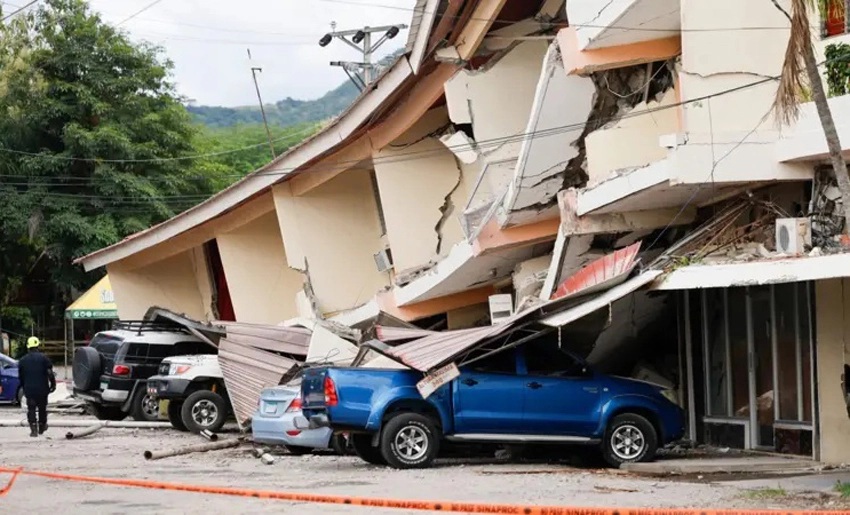
Foto: tomada de radioangulo.cu
More than 800 aftershocks, thousands of victims, and uncertainty in the provinces affected by the 7.5-magnitude earthquake of October 9 stand out today in Panama's news week.
According to the most recent official report, 15,139 people and 4,485 families were affected by the seismic event, while the Government maintains actions to assist the victims.
Minister of Canal Affairs and Secretary of Goals José Ramón Icaza reported that 3,696 people remain in 46 shelters, of whom 2,569 are in Veraguas province.
So far, one fatality is reported: a 68-year-old woman from Macaracas, in Los Santos province.
Authorities are also assisting 1,185 families whose homes suffered damage, while the Ministry of Social Development provided psychological assistance to more than 2,000 victims.
Coclé, Los Santos, Veraguas, and Herrera are among the provinces most affected by the earthquake, whose epicenter was near Pitaloza Arriba, in Herrera.
In the housing sphere, the Government is evaluating damage to more than 2,300 homes and has begun enabling the first 300 solutions through home construction, repairs, and delivery of materials.
For its part, the Ministry of Education inspected 519 schools with partial or total damage and will determine the resumption of classes based on the safety conditions of the facilities.
The emergency also prompted expressions of concern about inequalities in attention to affected communities. The Pueblo Unido por la Vida alliance denounced differences in state assistance and warned that lower-income sectors face greater difficulties in recovering their homes, livelihoods, and access to basic services.
The organization questioned the minimizing of the catastrophe's impact due to the low number of fatalities, emphasizing the material losses and the uncertainty facing thousands of people.
Among the geographic effects reported is Isla Cañas, in Los Santos, where, according to a television report, the terrain was divided by a channel about four meters deep after the phenomenon.
Amid recovery tasks, President José Raúl Mulino confirmed the cancellation of the traditional dawn reveille at the Presidency of the Republic, scheduled for the early hours of November 3, as part of national holiday celebrations.
The president indicated that the holding of parades will be evaluated at the next Cabinet Council before announcing a definitive decision.
Mulino justified the suspension of the reveille due to the situation the country is going through and the need to address the consequences of the disaster, which struck thousands of families.
Panama also received international cooperation to face the emergency. Among the contributions stands out a shipment of 40 tons of humanitarian aid from Venezuela, accompanied by 51 specialists destined to support technical evaluation and the recovery of damaged infrastructure.
The United States, Costa Rica, and Korea are also among the countries that have provided support, along with the United Nations World Food Programme and other agencies of the multilateral organization.
The earthquake occurred at 12:56 p.m. local time on October 9. The U.S. Geological Survey raised the magnitude from 7.6 to 7.7, while the Institute of Geosciences of the University of Panama placed it at 7.5, after an initial estimate of 7.2.
Add new comment