
Nuclear Threat: No Vest and Cane, but a Briefcase
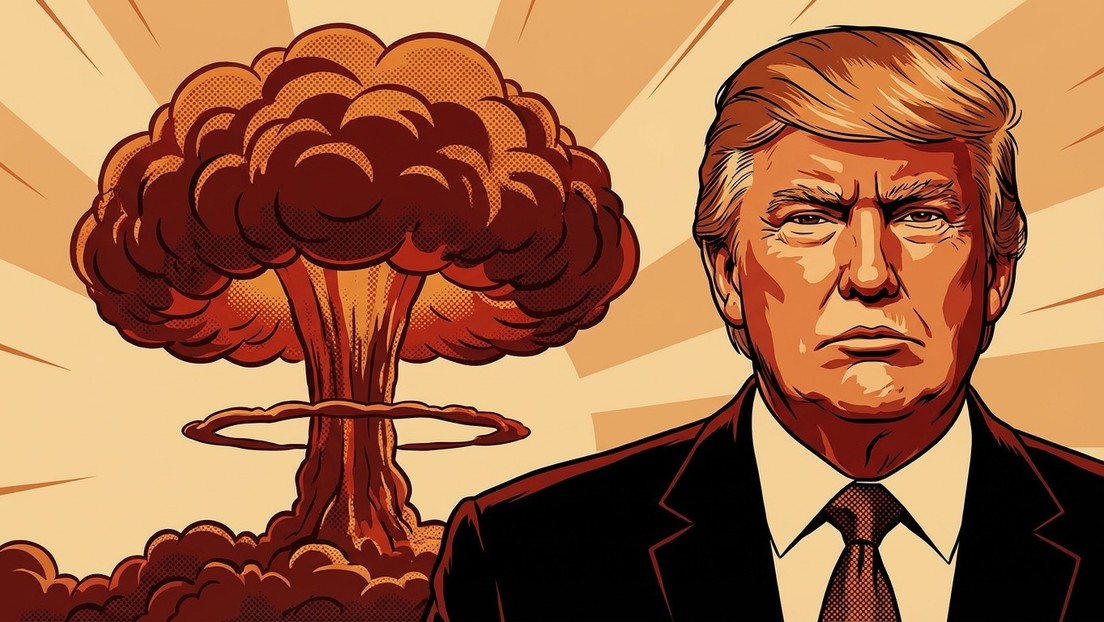
Now that the United States has allowed itself to be led by Israel into a war of aggression against Iran, which it threatens with total destruction, the danger of the conflict escalating into a third World War is once again gaining momentum, should imperialism use atomic weapons again, as it did 81 years ago against the populations of Hiroshima and Nagasaki in a Japan that was already defeated.
Paradoxically, the pretext is to prevent Iran from possessing nuclear weapons, and the opportunity could arise at any moment with a Trump who is constantly on the move, never far from the briefcase that could bring about the destruction of the planet as we know it.
It was former Washington Post reporter Michael Dobbs who called it "the ultimate power accessory, a doomsday machine that could destroy the planet," admitting that if "the twisted Hillary" was right about one thing, it was this: "Do we want Donald Trump's finger near the button?"
It should be clarified that these nuclear weapons aren't exactly controlled by a "button." The key to the potential end of days is a credit card-sized piece of plastic containing the codes needed to unleash hell.
However, when the president leaves the White House, the nuclear briefcase comes into play: a large leather satchel with aluminum trim, pulled by a military aide. This bag is key to authorizing a nuclear strike while he's away from the Oval Office.
Inside are four items: retaliation options, locations of classified sites, instructions for the emergency transmission system, and the launch codes.
Now this threat is being used again as a means of blackmail by a Trump who acts as he pleases and only respects countries that possess nuclear weapons, as Russian Foreign Minister Sergei Lavrov reminded us a few hours ago.
We have the example of the Democratic People's Republic of Korea, which, deceived several times by Washington, decided to acquire nuclear weapons, taking advantage of its advanced scientific capabilities. Therefore, the United States, with its South Korean satellite and its ally Japan, considered it absurd to launch an attack against a nation that already possessed such weapons and could launch them on American soil if it were the victim of aggression.
This, of course, deterred imperialism from embarking on such an adventure against a small nation with deadly weapons.
Now, in the midst of the Yankee-Zionist aggression against Tehran under the pretext of preventing it from building a weapon of mass destruction, American journalist Tucker Carlson (a former supporter of Donald Trump) believes this could push countries around the world to develop nuclear weapons as a security mechanism.
Carlson stated that most of the attacks launched by the United States have occurred...Under the "pretext" of "preserving world order." "That's not what we're seeing now" in Iran, he stated, but, according to "some indications," he said, President Donald Trump "thought that's what it was about: Iran wants nuclear weapons, it can't have them, we can't allow more nuclear proliferation."
However, this aggression will ultimately have a counterproductive effect, the journalist asserted: "It will radically accelerate proliferation worldwide." "Because the lesson is: it's better to have nuclear weapons or you'll have regime change," he stated.
NUCLEAR STATES
Currently, there are nine states that have successfully completed the development of nuclear weapons. Of this group, the Treaty on the Non-Proliferation of Nuclear Weapons formally recognizes five nations as "Nuclear-Armed States," since they were the first to consolidate this technology. These countries are the United States, the Russian Federation, the United Kingdom of Great Britain and Northern Ireland, the French Republic, and the People's Republic of China.
On the other hand, there are four nations that possess nuclear arsenals but are not party to the Nuclear Non-Proliferation Treaty. Three of them have confirmed their capabilities through official tests: the Republic of India, the Islamic Republic of Pakistan, and the Democratic People's Republic of Korea, the latter of which formally withdrew from the treaty in 2003. Operating outside this legal framework, their status as nuclear powers is not officially recognized by most international monitoring institutions.
Finally, the State of Israel completes the list of the nine states that have successfully developed nuclear weapons. Unlike the others, Israel maintains a policy of strategic ambiguity, neither confirming nor denying the existence of its arsenal, and it’s also not a signatory to the Nuclear Non-Proliferation Treaty. Despite this lack of official recognition, global intelligence reports agree that the country possesses an operational military capability, thus completing the current census of nuclear powers in the world.
WHO DECIDES?
The final decision to use nuclear weapons is always restricted to a single person or a small group of people.
The United States and France require their respective presidents to approve the launch of nuclear weapons. In the US, the presidential emergency briefcase is always handled by a close aide, unless the president is near a command center at a military base. In the United Kingdom, the decision rests with the Prime Minister. In the case of China, there’s no official information, but it’s generally believed that the launch of nuclear weapons rests with the Central Military Commission of the Chinese Communist Party. Russia grants this power to the President but may also require the approval of the Minister of Defense and the Chief of the General Staff. In the Democratic People's Republic of Korea, the Supreme Commander of the Armed Forces has the authority. India, Pakistan, and Israel have committees for such decisions.
Translated by Amilkal Labañino / Cubasi Translation Staff
Add new comment