
Noboa, a Petty Dictator in the Service of Organized Crime
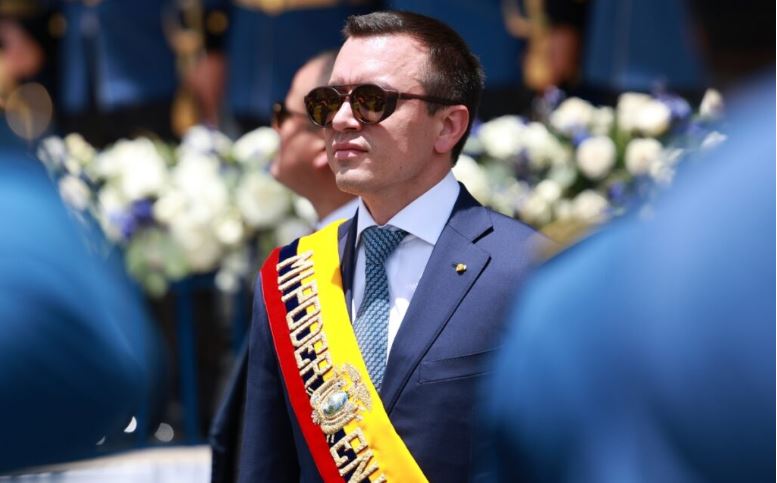
Without a doubt, President Daniel Noboa, born in Miami—like his friend Marco Rubio—has established a virtual dictatorship in Ecuador, backed by US President Donald Trump, with a leading position among the right-wing regimes on the continent loyal to the dictates of US imperialism.
All of this has emboldened him to continue the fraud he has perpetuated in the South American nation since assuming power, now with an eye toward the upcoming local elections. He has forwarded these elections under the pretext of preventing the El Niño weather phenomenon from affecting voter turnout, relying on yet another legal fabrication to frame the main opposition party, Citizen Revolution, with a false accusation of corruption. The party has been suspended for nine months, preventing it from participating in an electoral event already shrouded in the dirty veil of electoral fraud.
It’s not inaccurate to emphasize that the nine-month suspension of the Citizen Revolution by the Electoral Disputes Tribunal (TCE) is not justice, but rather fear of the ballot box. They want to exclude the main opposition force from the elections because Daniel Noboa knows that the people reject his administration, and with this underhanded maneuver, he is trying to prevent his National Democratic Action (ADN) party from being defeated in local elections.
This is happening with the complicity of Attorney General Alarcón and a TCE that has become a tool of the regime. This is truly a dictatorship, further boosted by the support of U.S. military forces present in the country under the pretext of helping to fighting crime, ignoring the popular will to deny entry to these forces, as specified in the Constitution. The wealthy president, however, disregards this.
NOBOA'S EXCUSE
Noboa claims that moving up the local elections to November 29 in Ecuador doesn't benefit his party, but rather aims to guarantee electoral competition by preventing a potential El Niño phenomenon from hindering voter participation.
That situation, in reality, would have strengthened the urban vote, where his political movement, National Democratic Action (ADN), "is stronger," he stated in an interview with Radio Gaviota, hypocritically noting that the date change is "ensuring" electoral competition.
Last Friday, the full National Electoral Council (CNE) moved up local elections to this year, justifying the move by stating that heavy rains and flooding could occur on the originally scheduled date.
But the president ignores the fact that Correism, the country's main opposition force, is currently suspended, so the measure seeks to prevent its candidates and the participation of parties opposed to Noboa.
In this context, EFE reports that former President Rafael Correa (2007-2017) called on his potential candidates for local offices to disaffiliate from his political movement, Citizen Revolution, so they would not face obstacles to participating.
The ruling by the Electoral Disputes Tribunal (TCE) "is a mandate from Daniel Noboa to eliminate the largest political organization in this country from the ballot box, an organization he knows will be a strong contender in upcoming elections," the report added.
In an attempt to halt the sanction, the political group filed a request to overturn the ruling. The proceedings against Citizen Revolution stemmed from a judicial investigation into the alleged wrongdoing of organized crime.
IRREGULARITIES
The Center for Economic and Policy Research (CEPR), based in Washington, condemned the party's temporary suspension.
It noted that the suspension "coincides with the Trump administration's launch of an alliance of right-wing Latin American presidents."
"There are a number of irregularities in the process," noted, pointing out that they have not been notified of a judicial investigation against the organization.
The Prosecutor's Office is investigating former presidential candidate Luisa González, of the Citizen Revolution party, in the so-called "Slush Fund" case, for allegedly receiving campaign financing from Venezuela.
"The judge could suspend the political organization for up to 24 months, but he's doing so for nine, with the sole objective of preventing Citizen Revolution party to register its candidates."
If the sanction cannot be lifted, the organization will seek alliances with other political movements.
CONAIE, Ecuador's largest indigenous organization and a strong opponent of Correa's policies, considered it "a serious event that weakens political pluralism."
WHO GOVERNS?
Noboa boasts that crime has decreased in the country and praises the collaboration of U.S. forces in this process. After the curfew in four provinces, where some 3,000 people were arrested, the same is now being done in nine more, conveniently ignoring the fact that his family, the richest in the country, has been sending bags of cocaine with impunity in the boxes of bananas it exports, mainly to Europe.
And the fact is that organized crime, the kind that is not being fought in reality, is the main governing force in the South American nation of Ecuador.
This makes the National Electoral Council (CNE) and the Electoral Disputes Tribunal (TCE), created by the 2008 Constitution, are currently suffering from political co-optation, a lack of independence, and insufficient oversight of campaign finance. Errors in the 2019, 2021, and 2023 elections, which favored the right wing, along with the irregular tenure of their authorities, have weakened the legitimacy of these institutions.
In parallel, the growth of organized crime since 2018, fueled by the institutional crisis and the loss of state presence in the territory, has allowed its progressive infiltration of campaigns and local governments.
Illicit sources of financing—drug trafficking, illegal mining, and corruption—are channeled to parties and candidates through opaque donations, vote buying, mass rallies, and logistical support. Furthermore, there has been a dramatic increase in violence, with the assassinations of candidates such as Fernando Villavicencio (2023) and several local officials. This violence has transformed campaigns into militarized arenas and jeopardized the conduct of free and fair elections.
Hence, organized crime has evolved toward more sophisticated forms of territorial and political control, influencing decisions of various kinds, depending on the level of government it affects.
Thus, a structurally vulnerable electoral system is evident: it lacks effective controls over financing, has captured institutions, and operates in a deteriorating security environment.
This has been exploited by the criminal empire to influence politics, generating citizen distrust of democratic institutions, delegitimizing political parties, normalizing political violence, and risking the consolidation of regimes where criminal actors influence state decisions, as is the case with Daniel Noboa's administration.
Add new comment