
Nigerians Rally in Solidarity With Cuba as U.S. Foreign Policy Draws Global Criticism
The United States has found itself increasingly at odds with much of the international community as it pursues an assertive and at times contradictory foreign policy across multiple fronts. Among its most consequential actions has been the imposition of sweeping tariffs on more than 90 countries as a political instrument, with nations including Brazil, India, Canada, Mexico, and Switzerland all facing significant increases. When the U.S. Supreme Court ruled on February 20, 2026 that the tariffs lacked proper congressional authorization, the Trump administration dismissed the ruling and announced a blanket additional levy on global trade.
Beyond trade, the administration has threatened to seize the Panama Canal, sought to annex Greenland, launched military strikes against Iran, invaded Venezuela and detained President Nicolás Maduro and his wife Cilia Flores in New York, and threatened military action against Colombia, Mexico, and Nicaragua. Cuba has also drawn particular attention from President Trump, who remarked that the island nation "looks like it's ready to fall."
The global response has been substantial. On October 29, 2025, 165 countries voted in the United Nations General Assembly demanding an end to the U.S. embargo on Cuba — a resolution that has passed annually for thirty-three consecutive years. All African nations, meeting on February 15, 2026, called not only for Washington to back away from Cuba but also to remove the island from its state sponsors of terrorism list.
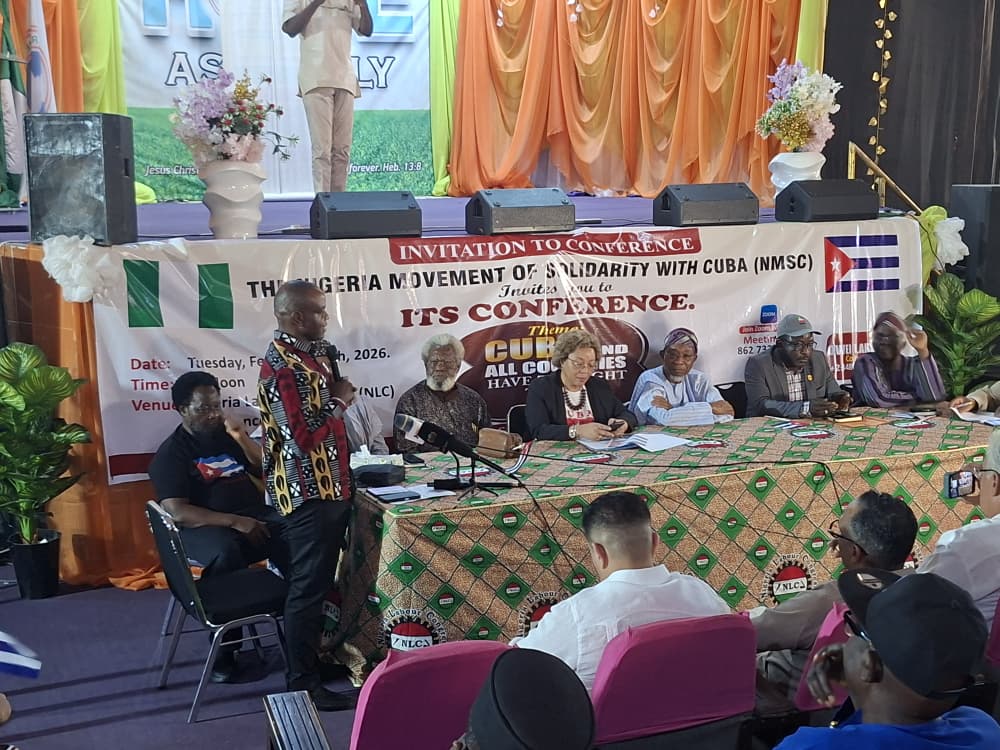
In Nigeria, that solidarity took concrete form on February 24, 2026, when mass organizations — including the Nigeria Labour Congress and the Trade Union Congress of Nigeria, alongside civil society coalitions, political activists, and veterans of the pro-democracy movement — convened in Abuja for a hybrid conference on Cuba, organized by the 42-year-old Nigeria Solidarity Movement with Cuba.
Former Interior Minister and Honorary President of the movement, Ogbeni Rauf Aregbesola, highlighted Cuba's historical contributions to African liberation, noting that the country lost approximately four thousand young people fighting for the independence of the continent. "We cannot but be historically grateful to a people who lost about four thousand of their youths under African skies fighting for the liberation of our continent," he said, adding that the majority of Cubans are of African descent.
The President of the Trade Union Congress, Festus Osifo, affirmed that the workers' movement stands firmly against economic blockades that undermine national sovereignty and the welfare of any people. Joe Ajaero, President of the Nigeria Labour Congress — Africa's largest labor federation — addressed the Cuban people directly: "You are not alone. Your struggle for sovereignty is the world's struggle for justice."
Former President of the West Africa Bar Association, Femi Falana, argued that African nations have a legal and moral obligation to help Cuba defend its sovereignty, given the island's unconditional support for African independence movements. Legal adviser Femi Aborishade echoed that sentiment, calling for concrete political and material solidarity rather than symbolic gestures alone.
Omoyele Sowore, leader of the African Action Congress, suggested that Nigerians consider crowdfunding in support of Cuba, drawing a parallel to the donations made during the struggle against apartheid. The National Secretary of the Nigeria Union of Journalists, Achike Chude, stressed that the Cuban people's fundamental rights to dignity must be upheld and protected.
The conference issued a series of demands, including the immediate lifting of all U.S. sanctions against Cuba in accordance with standing UN resolutions, the release of Venezuelan President Maduro and his wife, and a call for Nigeria, Angola, and South Africa to provide Cuba with urgent fuel and humanitarian supplies. The solidarity movement also announced a new leadership structure, chaired by founding member Comrade Salisu Nuhu Mohammed, tasked with deepening ties with Cuba solidarity movements across the African continent.
Add new comment