
More Than Six Decades With a Dagger Stuck in the Chest
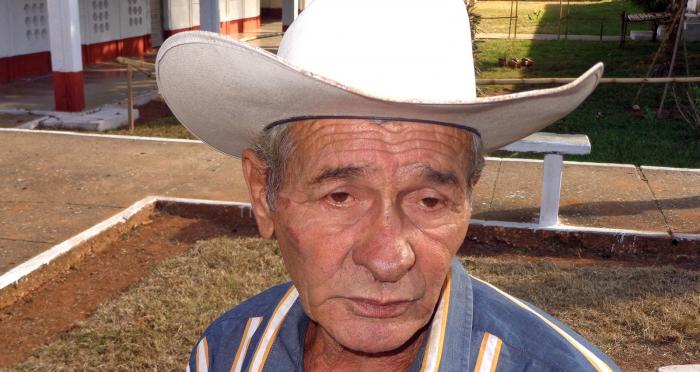
It is logical that when Julio Rodríguez Sánchez sees the production and defense brigades, militiamen and other defense structures preparing in the mountainous area where he lives, he thinks of the crucial days experienced by hundreds of Cubans who faced counterrevolutionary bands there—groups made up of thugs who murdered without any compassion and sowed terror wherever they went.
It is not only a historical evocation, but also painfully familiar. He was barely seven months old when—according to what he has been told since childhood—his father, Eliodoro Rodríguez Linares (Erineo), was brutally murdered, together with the young literacy teacher Conrado Benítez, by the band of the bloodthirsty Osvaldo Ramírez (January 5, 1961), in a remote spot called Las Tinajitas, in the San Ambrosio area.
The years have passed, but the pain is still there, nipping at his heels day after day, even though he cannot preserve a single memory of those afternoons when, arriving exhausted from the fields, Erineo would carry him in his arms and press him to his chest, like the most divine gift that life and his wife Adela Sánchez had given him.
With a mixture of tenderness and inevitable sadness, Julio told me this one of those fresh mountain mornings, when the dew smells of life, both of us sitting on a small bench near the little square where the students of the Conrado Benítez García school gather.
I do not know whether speaking softly is his peasant and respectful habit. I only know that in that tone he recounted—as if he had been an eyewitness—the spirit in which his father arrived in the area, coming from Fomento, "as a member of the militias, to fight against the bandits, and then, very much in love with my mother, he ended up staying here.
"I never heard anyone speak ill of him; quite the opposite: that he was a very noble, serious, hardworking man; that he got along very well with everyone… someone even told me once that he collaborated with the comrades of State security."
Moved by Julio's accounts, I search among publications and documents, like someone winding through the labyrinths of the mountain range, and I seem to see Adela, her face somber and pain splitting her chest in two as she tells—as she did in life, several times—the anguish she experienced from that bitter day, when "a certain Isidro appeared to tell my husband that Félix Torres wanted to speak with him. It was bait: they were rebels from Osvaldo's band.
"One day a man named Fulgencio Fondón came to my house to ask, on Erineo's behalf, for tobacco, a coat and other things. Later I learned that all of that was for the bandits. I did not know he was imprisoned. Erineo himself told me when he sent a little piece of paper in a cigar box saying that I should be resigned, that Osvaldo had caught him. Then I knew he would not return."
I can also imagine Julio, enduring in the midst of childhood his father's absence at school meetings, his mother's painful accounts, the references to the trap set against his father, the brutal way in which they deprived him of his life.
Among those testimonies is that of a peasant from the area named Eugenio Carpio:
"Erineo and I worked the land together, as a pair. Isidro Moscoso showed up there; that day I had bought a herd of cattle and Osvaldo Ramírez himself came out to meet me along the Sierrita. First he asked me about the cattle and then he wanted to know where Erineo was, clearing brush in the woods. It was clear that he knew in advance where the man he was looking for was. Then he sent Isidro for him…"
With deep sorrow Julio learned that, in order to sound out his father, that individual asked what he would do if he found Osvaldo, and ended up later telling the gang leader the brave and resolute answer of the peasant. One can imagine the reaction, the capture, the intentions, the unleashed fury...
After unhurriedly watching the flight of a dove that crossed the air above us, disappearing over the building destined for teaching at the mountain school, Julio evokes, in summary, what thousands of people were able to read in a piece titled "El calvario de San Ambrosio," published by the newspaper Escambray.
It is the revelation that, while a fugitive, a bandit known as Mirio Pérez Venegas made in those days to a State Security agent:
"At the camp it seemed there was a party that night (…) first they brought out Conrado Benítez, who with a rope around his neck had to walk quickly so as not to be dragged, while all those present hit him with sticks and stabbed him with knives.
"When he was beneath the tree chosen for his execution, the rope was passed over a branch, the literacy teacher's eyes looked around as if asking whether we were people or animals. The stones and stabbings did not cease for a moment, until Osvaldo ordered that we pull the rope. The body was suspended and lowered several times as if it were a doll, until the end of his life, when we left him up there. Despite being quite dead, Osvaldo ordered that we keep stabbing and beating him.
"After that it was the peasant's turn. He was brought in under the same conditions. We did the same to Eliodoro Rodríguez as to the literacy teacher, led by Osvaldo, who was always the first to torture and pull the rope."
AN ABYSS OF DIFFERENCE
While bands like those led by Osvaldo Ramírez himself, Julio Emilio Carretero or Cheíto León committed such crimes, men like Erineo calmly worked the land and young people like Conrado taught hundreds and thousands of people that reading, writing and counting numbers was not a mystery or something impossible to achieve, but one of the most beautiful and fundamental rights of every human being.
They say that when he was captured, the only weapons he carried were books and toys he had brought from his beloved Matanzas, eager to give them to children of the area and his students.
Very, very different from the barbarism unleashed by the bands in the Escambray had been the reality, barely three calendar years earlier, in equally mountainous places, but in eastern Cuba, occupied and defended by the guerrillas of the Rebel Army, with men like Fidel, Raúl and Almeida at the front.
History does not lie, does not exaggerate, does not minimize: in liberated areas of the Second Eastern Front, led by Raúl, nearly 400 schools were opened to educate the peasant and child population, the Rebel Health department was organized (which established some 20 hospitals and field medical posts to serve both combatants and residents), in addition to those conceived for Justice, Public Works, Treasury, Education, Propaganda and Inspection, and the Agrarian and Workers' bureaus.
Time has passed at the speed of its light. Countless people residing in or with family roots in the heights of the Escambray could offer sad testimony today about the mourning left by the vandalic passage of the counterrevolutionary bands that operated in the massif.
Not a single inhabitant, however, among the more than 500,000 who inhabited the Sierra de Cristal and other heights of the East, or their descendants, could harbor similar memories about the presence of the revolutionaries there.
That is why that morning Julio Rodríguez Sánchez dressed early in his best clothes, put on his cloth hat, set off for the school in Pitajones, greeted friends, talked with students and ended up absorbed like a child, on a chair, observing the special recognition presented to him by authorities of the territory and representatives of Education.
Surely at that moment his thoughts were very far away… perhaps guessing the expression his two daughters, now grown, would wear when he showed them the certificate, or perhaps thinking that from somewhere his father, the peasant martyr Eliodoro Rodríguez Linares, was watching him, with the same pride and passion of those days when, arriving exhausted from the fields, he would lift him in his arms and press him to his chest, between two lights, by moonlight, in view of the hills.
Add new comment