
Marco Rubio Distorts the Truth About Cuba
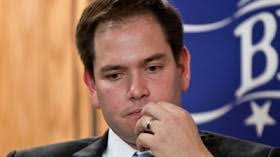
U.S. Secretary of State Marco Rubio distorted historical truth on Wednesday when referring to May 20, 1902, by failing to acknowledge that on that date Cuba ceased being a Spanish colony only to become a neocolony of the United States.
In a message posted on the social network X, the head of U.S. diplomacy depicted the day as Cuba's independence day rather than the date that imposed new yokes on the Cuban nation, initiating a period of intervention, interference, and dispossession. "On this day in 1902, the Cuban flag flew over an independent country for the first time," said the U.S. diplomat, who for about five minutes offered arguments that misrepresent not only the past but also the present.
Rubio knows, as he stated, that the Cuban people are enduring "unimaginable hardships," but what he presented as "the truth about the cause of their suffering" does not align with reality either. He stated that in Cuba people are "forced to survive 22 hours a day without electricity" — something that is true. "They have no electricity, no fuel, no food" — also true. But he lies by repeating the same rhetoric of a "failed state" and blaming those who "control the country."
The Secretary of State wants to make people believe that the oil embargo he mentions is not among the causes that have reinforced the multidimensional blockade — now more than six decades old and described by many as the longest blockade against any country in history — and that this blockade is not responsible for driving the people of a small nation to levels of asphyxiation.
That objective was meticulously detailed in a memorandum by Lester D. Mallory on April 6, 1960. That secret State Department document established the foundations of the blockade policy against Cuba. In that writing, Mallory defined the strategy of weakening support for the Cuban government through economic deprivation, seeking to provoke hunger and discontent among the population. The intention was to create a climate of disappointment and discontent, leading to the implementation of the economic, commercial, and financial embargo that persists to this day.
Thus, the Secretary of State calls for building "a new relationship" with Cuba and, as the "great savior," says: "I want to tell you what we in the United States offer not only to alleviate the current crisis but also to build a better future." Why not lift the blockade, as the international community has overwhelmingly demanded on more than 30 occasions in the United Nations General Assembly?
And yes, before 1959, May 20 was celebrated in Cuba as national independence day — that is what was taught in schools before January 1 of that year. Cuba's history had been completely falsified in the interest of the sitting governments.
In 1898, after 30 years of heroic struggle, the Cuban Liberation Army (the Mambises) had practically defeated the Spanish colonial army. It was then that the United States government seized the opportunity, using the explosion of the battleship Maine as a pretext to satisfy its long-held desire to intervene on the island. That was the so-called Spanish-Cuban-American War, the first imperialist war in human history, as defined by Vladimir Ilyich Lenin, leader of the world proletariat.
Add new comment