
The International Peoples’ Assembly Rises in Solidarity with Cuba
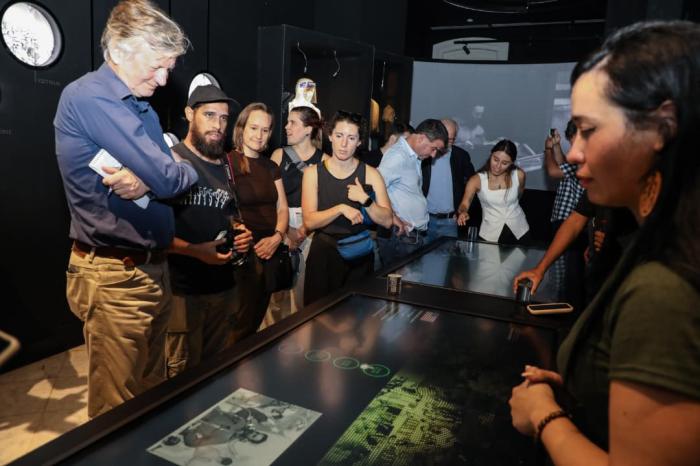
Los delegados de la AIP se acercaron también a la historia de Cuba a través de una visita al Centro Fidel Castro Ruz. Foto: Dunia Álvarez Palacios
In a global context where wars have become—for some—a highly lucrative business, there is an island in the Caribbean that has endured another form of aggression for more than six decades: the economic, commercial, and financial blockade, intensified in recent weeks.
Its severe consequences across all spheres of daily life for the Cuban people are widely known around the world. Food, transportation, electricity, health care, education, and sanitation all face an extremely complex situation, one that a delegation from the International Peoples’ Assembly (IPA) has come to witness firsthand.
At a press conference held Tuesday at the Fidel Castro Ruz Center, João Pedro Stédile, a member of the National Leadership of Brazil’s Landless Workers’ Movement (MST), explained the objectives of the working visit. First, he said, “we want to express our solidarity with the Cuban people and government.”
He also added that the delegation aims to learn directly about the effects of Washington’s sanctions, as well as the measures adopted by the Cuban government and civil society in response. Likewise, they will gather “opinions and suggestions to take back to our countries and develop concrete actions of solidarity.”
In response to Granma, Brian Becker, leader of the Party for Socialism and Liberation (PSL) in the United States, noted that in their effort to better understand the reality of the largest island in the Caribbean, they have already visited the Latin American School of Medicine, where hundreds of doctors from various countries have graduated and where many others are currently studying.
They have also visited several hospital institutions, as health care is known to be one of the sectors most affected by the blockade. “Despite the fact that the island has a first-rate health care system, the Cuban people need medicines and medical supplies,” he stated.
“The cruelty of the blockade is evident in the restrictions on obtaining medicines, including in special cases such as children with cancer,” he emphasized. After completing their planned visits—although the stay will be short—“we will return to our countries to inform others,” he said, so that people can learn about what Cuba is experiencing.
For his part, Fred M’membe, president of the Socialist Party of Zambia, stated that the delegation will speak not only with the country’s leadership but also with ordinary people in the streets. “Reality cannot be hidden. It is not difficult to understand what is happening once we are here,” he remarked, recalling that the IPA has visited the archipelago on several previous occasions.
M’membe added that no country has had to endure an aggression as severe and prolonged as the one faced by the Caribbean nation. “The Cuban people do not deserve this,” he said. “The only threat Cuba represents is the kindness of its people,” to whom, he insisted, “Africans express our gratitude” for their cooperation in health care, education, and the struggle against colonialism. This, he said, is the moment to rise in solidarity with Cuba, which, before the world, stands as a moral authority.
Among the IPA delegates are also representatives from Colombia, Italy, India, and Argentina.
Add new comment