
In Havana, a Cycle of Exchanges with Municipalities Ends, but Not a Work Method
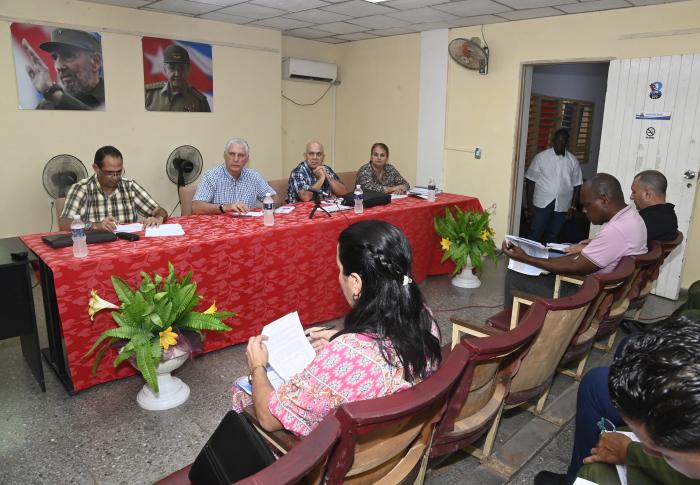
Recorrido del Presidente Díaz-Canel por municipios de La Habana Foto: Estudios Revolución
With the visit of the President of the National Defense Council, Miguel Díaz-Canel Bermúdez, to the Municipal Defense Councils of Cotorro and Habana del Este, a phase of exchanges between national leaders and municipal authorities across all 15 territories of Havana concluded on Wednesday afternoon.
This round of visits has drawn to a close, but this method of analyzing the issues with the greatest impact on the lives of Havana residents—and doing so from the perspective of these localized settings—has not come to an end. There is no conclusion because, as the dignitary expressed in both municipalities, new exchanges will take place shortly.
This approach will continue in order to keep monitoring a situation facing major challenges caused, essentially, by an intense effort from the U.S. government targeting those who live on and seek well-being across the island.
On Wednesday, it was evident that while each Municipal Defense Council has its unique characteristics, common issues also link territories like Cotorro and Habana del Este.
The distribution of electrical energy and the urgent need to secure water service, for instance, are equal priorities for authorities in both areas, as was explained to national leadership during a session that also included the presence of Roberto Morales Ojeda, member of the Political Bureau and Secretary of Organization of the Central Committee of the Communist Party of Cuba.
Other shared priorities involve assisting vulnerable individuals, as well as increasing food production and ensuring its effective distribution. This was made clear during a meeting that was also attended by the President of the Provincial Defense Council of Havana, Liván Izquierdo Alonso, and the Governor of the capital, Yanet Hernández Pérez, among other officials.
Gauging public sentiment remains one of the most effective tools for political work. That reality was strongly evident in both meetings, where the Head of State inquired about the number of retirees, how many individuals are disengaged from education and employment, how many are vulnerable, and the potential of new economic actors emerging in society to help build solutions.
Because the Family Care System (SAF) serves vulnerable individuals who require specialized nutritional support, the operation of this mechanism again drew the President's interest. Similarly, expanding the use of Renewable Energy Sources (FRE) occupied a prominent place in the discussions, with an emphatic call from national leadership to continue encouraging an increasing number of entities to operate using this type of resource.
On Wednesday afternoon, the First Secretary of the Central Committee of the Communist Party of Cuba posed several specific questions: "How many retirees have yet to receive their pensions? Are food sales fairs being conducted? How is the Community Youth Network progressing?" Authorities from each Municipal Defense Council shared details regarding ongoing efforts to ease daily life for citizens. It is an extensive, day-to-day effort managed with precision to keep pace with the challenges people face.
The municipality, as President Díaz-Canel Bermúdez reflected, is the place where solutions are and will continue to be achieved—especially those involving the mobilization of every resource capable of generating well-being, as well as advancing local autonomy, which is now at the center of key discussions as Cuba undertakes a path of 176 economic and social transformations.
Add new comment