
Get Serious, Please!
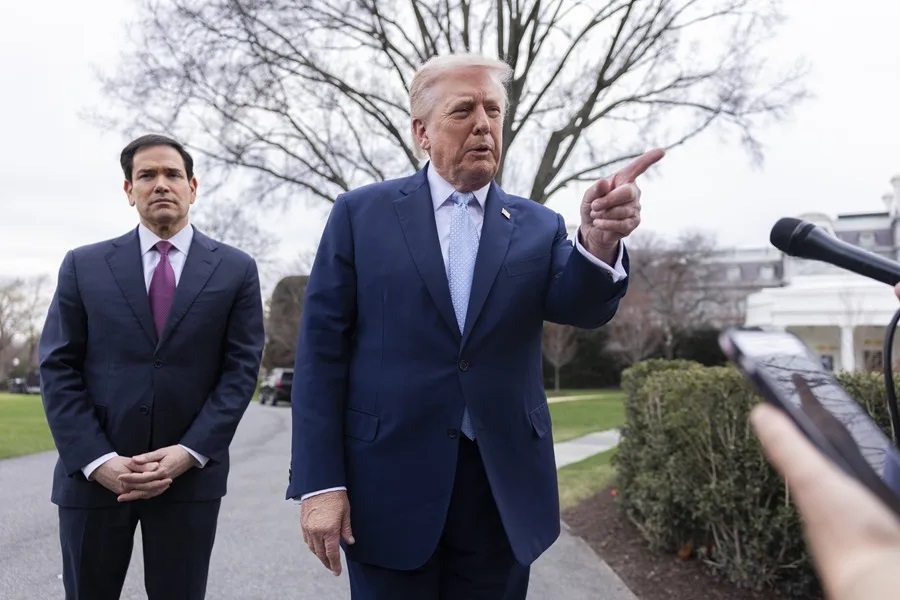
The latest remarks made by Trump and his secretary, Marco Antonio Rubio García, regarding Cuba, seem like something out of a bizarre, ridiculous script.
Naturally, in Cuba, authorities and the general public are viewing these statements with cautious attention. For these scoundrels—Trump and Rubio García—this might be a failed attempt to appear likable (to whom, exactly, remains unclear), but they possess enough power to trigger a catastrophe and drag the armed establishment of the "Federative Dis-republic of the United States" (the "DEF"—a play on the U.S. acronym) into yet another dead-end adventure. Let’s not forget that the U.S. leader once promised to wipe out the ancient Persian civilization. At a campaign rally for the Republican candidate for governor of Florida—held on the 23rd at the Alico Arena on the Florida Gulf Coast University campus—President Donald Trump took the opportunity to once again threaten Cuba. He did so almost as if weary of the subject, in response to a question posed “spontaneously” by one of the attendees.
True to his characteristic style, Trump pledged to send a warship to intimidate the Cubans—citing, in the process, some preposterous details, such as positioning the vessel a mere 46 meters from the coast. It is hardly worth analyzing such an absurd claim; in any case, anyone interested can learn that, back in April 1961, U.S. Navy ships positioned off Playa Girón (the Bay of Pigs) were—conveniently—sunk.
The situation practically writes its own punchline. Immediately, a flood of memes appeared—and that is no exaggeration—mocking the U.S. president’s bellicose promise. They poked fun at the nonsensical claim about the ship’s proximity to the shore—as if it were a stone’s throw away—and one person even speculated that, given the ship might be arriving from Iran, any Marines suffering from the recent defeat they took at the hands of the Iranians could perhaps be treated by Cuba’s renowned healthcare system. Other images—generated by AI—circulated, showing aircraft carriers with clogged toilets or depicting various other mishaps the U.S. military has reportedly encountered during conflicts in the Strait of Hormuz.
To top it all off, Senator Marco Antonio Rubio García joined in on the “joke.” Taking to the social media platform X, he urged Cubans to join the Central Intelligence Agency—the CIA—though he did add the caution that they should do so “discreetly” (thank goodness he clarified that). I have been patiently searching for any precedent for the implementation of a serious recruitment program for secret agents via X—as if it were a job posting for a gardener, an accountant, or any other profession. It’s truly astonishing.
Following this recruitment call on X, a flurry of memes and mockery directed at the “poor” Rubio García emerged. Half-seriously, half-jokingly, some internet users reminded the Secretary of State that the concept of “holding multiple jobs” (or, in this context, dual roles) actually originated in Cuba—specifically when individuals who were supposedly CIA spies turned out to be agents of the Cuban counterintelligence body. This proved remarkably effective in protecting Cuban sovereignty and, for instance, preventing more than 600 assassination attempts against the Cuban leader, Fidel Castro Ruz. In short, there is no shortage of experience in this regard—and, naturally, in other areas as well.
Beyond the confusion currently displayed by these high-ranking U.S. government officials—starting with President Trump himself—it’s worth examining the context and scope of this situation. One must ask: why create such a spectacle over matters that ought to be handled with the utmost seriousness—such as the announcement that a sovereign nation could be attacked in order to forcibly change its leadership?
Consider the electoral context—though perhaps not in the way most people assume.
What immediately stands out is that both statements were made just 11 days before the midterm elections—elections that do not look at all promising for the Trump-aligned administration. Regardless of how one views it, the partisan, election-oriented nature of the message is clear or Trump’s approach—which includes the very location where he makes his statements: South Florida, home to the largest concentration of voters of Cuban origin.
However, the dispassionate electoral data point in a different direction. If we assume that the only people truly in favor of invading Cuba are those born on the island—or the descendants of Cubans who emigrated—then the first problem is that this demographic accounts for barely 6% of the entire Florida electorate. Furthermore, at least 33% of that group now identify as Democrats.
Trump is surely aware of these statistics. This raises a reasonable question: why all the bluster? There are two possible explanations. First, there may be a concern that this share of the vote is at risk of shrinking, given that "MAGA Latinos" are grappling with the same hardships as the rest of the American public. Or, perhaps more logically, the message is primarily aimed at donors of Cuban origin—some of whom boast about their friendship with Trump. The priority is securing the funds; as for the voters, they may well have written them off.
And this is not merely wishful thinking. Consider the candidate Trump is backing for governor of Florida, Byron Donalds: he doesn’t have much to celebrate. Even though his patron—the blustering former president—won the state by a 13-point margin in 2024, the current race is extremely tight. Polls consistently show the Democratic candidate, David Jolly, hovering around 48%, while Byron Donalds sits at 43%. Anyone who has followed recent electoral processes in Florida can imagine what a disaster it would be for the Republicans to lose control of the state.
As for the elections for the House of Representatives and the Senate—still focusing on Florida—things do not look good for "Trumpism" either. Briefly, in the counties of South Florida—home to the majority of Cubans who have become U.S. voters—the available figures are striking. As of October 22, projections based on those who have already cast their ballots and declared their party affiliation show the following: Miami-Dade (Miami): Democrats lead Republicans by 7 points; Hillsborough (Tampa): +7 points; Orange (Orlando): +22 points; Palm Beach (where the president’s residence, Mar-a-Lago, is located): +22 points; and Broward (Fort Lauderdale): +35 points.
Another even more "curious" detail: based on the same criteria, in the districts held by the three lawmakers of Cuban origin who are the most staunchly anti-Cuban, the situation suggests they are at risk of losing their seats. In District 23 (Díaz-Balart), Democrats lead by 19 points; in District 27 (María Elvira Salazar), they lead by 7 points; and in District 28 (Carlos Giménez), they lead by 4 points.
It should be noted that these figures reflect early voting; therefore, it is urgent for the Republicans to ensure a massive turnout of their voters on November 3 to avoid such a defeat—so, be prepared for any kind of statement, no matter how outlandish it may seem.
Addressing the situation at the federal level—across the remaining 49 states—would require much more space. It’s worth noting that the outlook is likewise highly unfavorable for the Republicans, even in states “usually” under their control, such as Alaska or Texas. At this stage, it seems indisputable that the opposition will take control of the House of Representatives starting in January 2027; the prospect of the mandatory party retaining control of the House “has all but evaporated,” according to a report from the nonpartisan election forecasting platform *The Cook Political Report*.
Given this situation, one might reach a conclusion similar to the one applied to Florida: if the general vote appears lost, then messaging must be directed toward donors—and, of course, toward securing the so-called “hardcore” base: the zealots and the most easily manipulated. The goal is to ensure they do not choose to abstain out of frustration with the “unexpected” deterioration of their current circumstances. This is not about disapproving those who think differently; the hope is simply that they might, at the very least, engage in some actual thinking.
Looking more closely at Rubio García’s remarks regarding the CIA and other such matters, the issue of elections—a subject of vital importance to him—remains ever-present. His future depends entirely on this, as he cannot step away from politics; it is the only *modus vivendi* he knows.
Furthermore, Rubio García warrants closer scrutiny, as he is a far more sinister and shadowy figure than the leader himself. Unlike Trump—who has explicitly threatened Cuba on at least five separate public occasions since January 2026—no such direct threats appear to come from his secretary —though left implicit—that he insists on changing the legitimate Cuban government, by any means necessary. This is evident in the at least ten occasions during that same period on which Rubio García made official, public references to Cuba.
Does this mean that Secretary Rubio García has plans that differ from those of President Trump? Well, there is clear alignment on the strategic level—namely, “ending communism as a desirable future”—but in the way they broadcast their respective stances, certain tactical “discrepancies” arise.
Trump, for instance, proposes an expedited solution—such as sending a ship to force an immediate surrender by the Cubans. In other words, he wants a “fast and furious” conclusion—much like the film franchise about cars racing toward nowhere. Of course, this approach has not worked for him in Iran; it remains a mystery—even to psychologists and psychiatrists—why he believes it would succeed in the case of Cuba.
Rubio García, meanwhile—having spent more time studying “the Cuban regime”—has likely concluded that the President’s vision is unachievable. His preferred solution is the current status quo: a policy of total blockade aimed at breaking the Cuban people’s will to resist. It is his “wet dream”—one he pursues with apparent patience—to facilitate the return of the descendants of the Cuban oligarchy that was ousted in 1959; in other words, the very people who “invented” Marco Antonio Rubio García.
In essence, the Secretary of State’s strategy involves the CIA identifying potential leaders who, when the Cuban people can no longer endure their situation, would spearhead a popular uprising. At that point, the “Trump option” would be activated: U.S. Marines would arrive “to save the Cuban people”—much as they did in Afghanistan, Iraq, Libya, and elsewhere.
Something very murky must be going on—there must be a great deal of frustration in the corridors of power, especially at the State Department, for Rubio García to resort to the social network X to appeal to the CIA. This move renders the objective impossible from the start—a disaster foretold, if you will—ultimately reducing a call for new recruits to something akin to a mundane human resources task, transforming the high-and-mighty Secretary of State into a shadowy operator scrambling for scarce personnel.
In politics—and in the movies, for that matter—the recruitment of a group of "hardened" spies (drawn from the very population they are meant to target) should, by definition, be entirely secret. Yet, as part of this charade, the CIA itself has released a video instructing aspiring "007s"—in a distinctly "Miami-style" fashion—on how to proceed. In short: zero secrecy. This actually exposes another facet of the problem: given the nature of the Agency’s operations, they cannot be made public—a convenient arrangement that keeps the anti-Cuban camp "entertained and expectant," even if there is never any actual result. It is truly surprising how predictable they are!
If there were any seriousness to this endeavor, one might also note that the CIA seems to have forgotten the risks of "moonlighting." On an institutional level, it suggests they have run out of counter-revolutionary ringleaders and are now desperate to reorganize their "hardened" anti-communist troops in Cuba—a daunting and frustrating objective indeed.
Rubio García’s blather on X—an attempt to rally potential traitors, bought off with the CIA’s ill-gotten funds—labels the Cuban government as "failed" and "corrupt." In reality, however, he is describing his own side—starting with his boss, Trump, who is $2.5 billion richer today than he was when he arrived at the White House in January of last year. It is all part of the very blunder in which he finds himself adrift; his subconscious—which often reveals one’s true feelings—simply betrays him.
Finally, it seems Rubio García forgot another “detail” when he spoke out. On October 28, the UN will vote on a resolution against the blockade of Cuba—a process he has gone to great lengths, and resorted to various underhanded tactics, to try to derail. Does he really think these threats—along with his delusional posts on X—are helping his cause? Does this self-styled “super-diplomat” for the Trump camp not realize that, given all this, it becomes impossible to keep claiming that Cuba is a threat?
Frankly, it all comes across as a poorly conceived farce that leaves these unhinged individuals—who currently steer the ship in the D.C. administration—looking utterly ridiculous. They seem to be drifting further and further into a parallel universe, completely detached from reality. In their characteristic arrogance, they fail to grasp that if they continue down this path, even their future posturing and threats will no longer be taken seriously by those they target.
Worse still, their own followers—who, as previously noted, lack any original ideas of their own—are the ones most blatantly victimized by this mockery of common sense. It is only a matter of time before the plea, “Please, can you just be serious for once?” goes viral across MAGA social media circles, directed squarely at Trump and his associates.
How Cuba responded
While the American public tries to process the situation—and their leaders continue to peddle tall tales—the Cuban government has responded immediately. Cuban Foreign Minister Bruno Rodríguez Parrilla, also writing on X, explained to President Trump that such a ship would surely encounter plenty of "diente de perro" ("dog’s teeth")—jagged, coral-limestone geological formations that make parts of the Cuban coastline unnavigable. One might add that the "invaders" might even run into some "patriotic" dogs—the kind that live peacefully on land—provided, of course, that they even manage to make landfall.
And Cuban President Miguel Mario Díaz-Canel Bermúdez concluded: "It is worth remembering that, as of January 1, 1959, we Cubans achieved our true independence, and we are determined to defend it."
Add new comment