
French Government Under Pressure
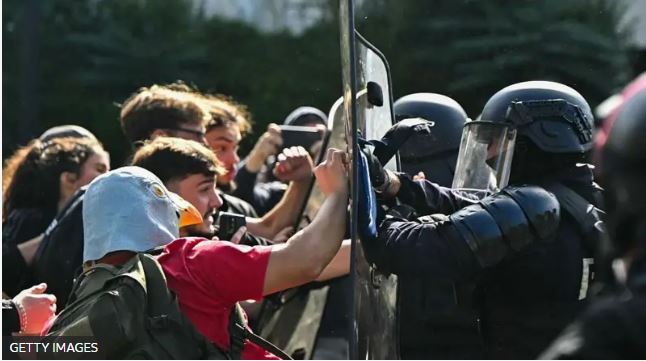
In addition to an inconsistent and reckless foreign policy—which has led France to meddle in and take an active role in a dangerous confrontation with Russia—President Emmanuel Macron has committed further “oversights” in domestic policy. These have weakened his position against his primary political rivals, most notably his confrontation with the tens of thousands of students who are demanding better conditions to continue their education. As of this Friday, a large number of educational institutions remain closed, while students prepare for further days of strike action. Meanwhile, the executive branch has failed to act transparently, instead blaming its own errors on the infiltration of leftist groups into the demonstrations—protests that have been met with a crackdown resulting in hundreds of injuries and thousands of arrests.
The movement is calling for greater resources for education, with demands ranging from addressing teacher shortages to improving access to universities. There are approximately 3,700 French secondary schools (*lycées*), serving around 2.2 million adolescents.
"Nothing will stop us until there are 10 billion euros on the table," Riad Rani, president of the Secondary Students' Union, told the television network BFM-TV. This figure corresponds to the "ten emergency measures" published on Monday on a platform shared by both secondary and university students.
The protests began on September 17 at the Saint-Exupéry *lycée* in Créteil, a town southeast of Paris. That day, a group of teachers went on strike to denounce staff shortages. They reported a lack of teachers for mathematics, French, literature, and history, as well as a missing deputy principal and insufficient social support staff, while the school nurse was on leave.
That same afternoon, students joined the protests. The following day, they placed trash containers in front of the school entrance and demonstrated alongside their teachers. "We are only asking for the bare minimum," the students repeated.
The movement spread to other institutions facing similar issues—initially in the Paris suburbs, and later in other regions. By the following week, protests were taking place in dozens of *lycées*, and student organizations began coordinating their actions. Since then, there have been four major days of mobilization—on September 29 and October 1, 6, and 8—which the students refer to as "actions." In just a few days, the blockades spread from a few dozen institutions to hundreds, eventually affecting more than 1,000 high schools by October 1. Social media played a key role in disseminating calls to action and sharing images of the conditions in which these young people study.
Although the demands at the start of the mobilizations varied from one institution to another, secondary and university student organizations eventually consolidated them into ten "emergency measures." To address these, they are calling for an investment of the aforementioned 10 billion euros ($11.21 billion).
One of the primary grievances concerns the shortage of teachers and staff. At the beginning of the academic year, 53% of public middle and high schools in France were missing at least one of their scheduled teachers. The Ministry of Education estimates that, during the 2024–2025 academic year, approximately 10% of planned instructional hours in high schools went untaught.
They are also protesting the number of students per classroom. The average was 30 in 2025, compared to 27 in 2010, though some teachers report having even larger classes. One teacher, who took part in a demonstration this Thursday in Marseille, stated that she has 37 students and that, before starting their classes, they must ask students to find available chairs and desks in other classrooms.
The condition of school facilities is another major grievance. Videos shared by the students themselves show issues ranging from leaks and flooded restrooms to the presence of rats and cockroaches. During the heatwaves of the last Northern Hemisphere summer, temperatures in some classrooms reached 38 degrees Celsius (100°F). Furthermore, students have raised concerns about the length of the school day; some sessions can begin at 8:00 a.m. and end at 6:00 p.m.
Another issue uniting both secondary and university students is 'Parcoursup,' the national platform for higher education admissions. Critics argue that the system lacks transparency and may exacerbate inequalities among students from different socioeconomic backgrounds. University students are also calling for 250,000 additional university spots and improved scholarships for students with fewer financial resources.
As the protests have continued, a new grievance has emerged regarding the conduct of security forces. "Too young to be heard, old enough to be tear-gassed" is one of the slogans used to denounce police actions.
Joining the movement
The protests began in schools in Paris and its suburbs, spreading to cities such as Marseille, Lyon, Lille, Nantes, Montpellier, Bordeaux, Toulouse, and Rennes.
University students subsequently joined the movement. Organizations such as 'Union étudiante' and 'UNEF' incorporated issues specific to higher education—such as access to universities and master’s programs, scholarships, and the cost of living for students—into the movement's demands.
Teachers and other education workers have also joined the cause. Several education and labor unions supported the days of mobilization, while the FCPE—the country’s main federation of parents—stated that the young people were bringing attention to issues that families had been pointing out for years.
The protests, however, were accompanied by episodes of violence. On Thursday, incidents were reported in Bordeaux, Saint-Étienne, Toulouse, and Marseille. The government maintains that far-left groups and anarchists infiltrated the demonstrations—a claim that student and teacher unions acknowledge in some instances, though they reject the notion that such a presence defines the movement.
Beyond the budgetary tensions, there’s also the issue of how the protests are being handled. The government is attempting to calm tensions while avoiding a deep dive into accusations that the police have used excessive force. On Wednesday, it suspended the use of stun grenades during the demonstrations after a teenager lost a hand.
All of this is taking place six months before the presidential election, in which Emmanuel Macron cannot run for a third term. The protests have already become part of the contest among those aspiring to succeed him.
Far-right leader Marine Le Pen focused on the destruction caused and advocated for a reduction in public spending, while leftist Jean-Luc Mélenchon expressed support for the students and denounced police violence.
According to an Elabe poll for BFM TV, 72% of French people consider the students' demands legitimate, yet 55% believe the protests should come to an end.
In any case, up to 500 educational institutions across France will be fully or partially closed this Monday due to the student protests, as the government’s announcements were deemed insufficient. Consequently, leaders of the movement have already called for another day of protest for next Tuesday, October 13.
Translated by Amilkal Labañino / CubaSí Translation Staff
Add new comment