
Frei Betto Analyzes Cuban Sovereignty Against the Empire
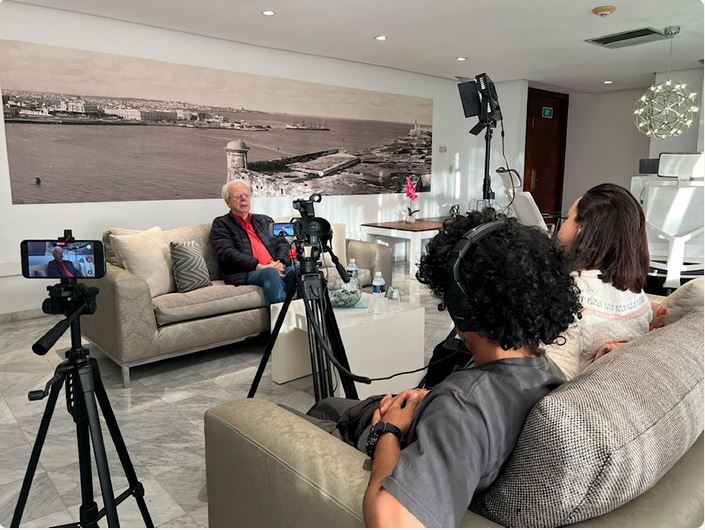
In an exclusive interview with Alma Plus TV, Brazilian theologian, writer, and revolutionary Frei Betto offered a thorough analysis of Cuba's present situation, the nature of American imperialism, and the importance of historical memory as an instrument of resistance.
With characteristic clarity, Betto reflected on the legacies of Fidel Castro and José Martí, as well as the role of new generations in defending national sovereignty.
"Imperialism Is Powerful, but Cuba Has History"
Betto opened his remarks by characterizing the United States government as an "empire" that adheres to the Monroe Doctrine and operates with the conviction of being the "emperor of the world" — a posture he argued has intensified under the administration of Donald Trump.
In response, he stressed the need to "keep confronting and fighting, just as so many before us — like Bolívar, like Martí, like Fidel — keep fighting to achieve our sovereignty and independence."
For Betto, sovereignty is not an abstract concept. It depends on a people's capacity for self-governance free from external interference, the achievement of economic autonomy, and what he termed the "census of Cubanness."
"That strong sense of self-worth a people feel from belonging to a nation, from being a citizen of that nation, knowing its historical roots and feeling like a co-participant in the national project," he emphasized.
"We Don't Have Globalization — We Have Gloco-Colonization"
The Brazilian theologian was direct in his characterization of the global context: "I have always said that we don't truly have globalization — what we have is gloco-colonization: the imposition onto the planet of a hedonistic, consumerist model of society, which is the capitalist model hegemonized by the United States."
In that context, he warned, "the sovereignty of all our fragile countries — like Cuba, like Brazil, like Colombia — is permanently under threat."
For Latin America to achieve true sovereignty, he said, "we must somehow neutralize the United States." Betto predicted that this change will come from an "endogenous factor": the internal decomposition of American society itself, marked by inequality, drug consumption, and armed violence.
"It is a society in decomposition," he stated, though he was careful to clarify: "I have affection for the American people — the problem lies in the government, in that imperialist government."
The Rise of the Right and the Power of Big Tech
During the interview, Betto also analyzed the global advance of the right wing, which he defined as "racist, misogynistic, homophobic," attributing this phenomenon to two key factors: the transition from an industrial economy to financial speculation, and the power of major technology corporations.
"The digital world is controlled by six or seven 'big techs' — all of them private — and these actors use that extraordinarily powerful tool as a means of recolonizing our peoples," he said on Alma Plus TV.
He underscored the urgency of establishing "very strict laws to prevent this ideological invasion that arrives through social media, affecting our values, our history, our principles, and our sovereignty."
Cuba: A History That Fuels Resistance
Betto emphasized that Cuba's strength lies in its deep knowledge of its own history.
"I know of no other people in Latin America that has a knowledge of its history like you Cubans do," he said. "Cuba has historical roots that are extremely strong and consistent. That is what has allowed Cubans to resist throughout this entire period of the Revolution — 67 years of Revolution," he stressed.
He recalled pivotal moments such as the Bay of Pigs invasion, the Missile Crisis, and the Special Period, drawing comparisons to the current "suffocation decreed by Donald Trump," which has included placing Cuba on the list of state sponsors of terrorism and tightening the economic blockade.
Youth and the Legacy of Fidel
For the theologian, the work of providing ideological and political formation for the younger generation is "increasingly urgent" — a concern he voiced given the pressures facing Cuba's youth.
He warned that without such formation, a people loses knowledge and understanding of its own history. "People lose hope, they despair, they want to leave the country, or they begin to entertain the idea that perhaps it would be better if this country became a capitalist one."
In response, he invoked the tenacity of Fidel Castro, who landed with the Granma expedition with fewer men than weapons and pushed forward in the face of aggression.
He asserted that Cuba's foremost weapon is its ethical example. "Cuba did not have — and does not have — the economic or military capacity to confront its enemies, but it has a capacity, a moral stature that other countries do not possess. That moral stature was embodied in Fidel. That ability he had to confront enemies — not with weapons, not with military systems, but with his towering moral authority."
"We Are All Fidel"
Betto stressed the need to make Fidel's thought and example accessible to all — just as Fidel himself did with Martí — and concluded with a call to action.
"When Fidel died, everyone said: 'We are all Fidel.' And now is the moment to prove it. Are we truly all Fidel? Are we prepared to enter the struggle as Fidel did and resisted in the face of so many adversities?" he posed.
Add new comment