
Fidel Castro's Thought Remains Alive, Scholars Affirm from Guatemala
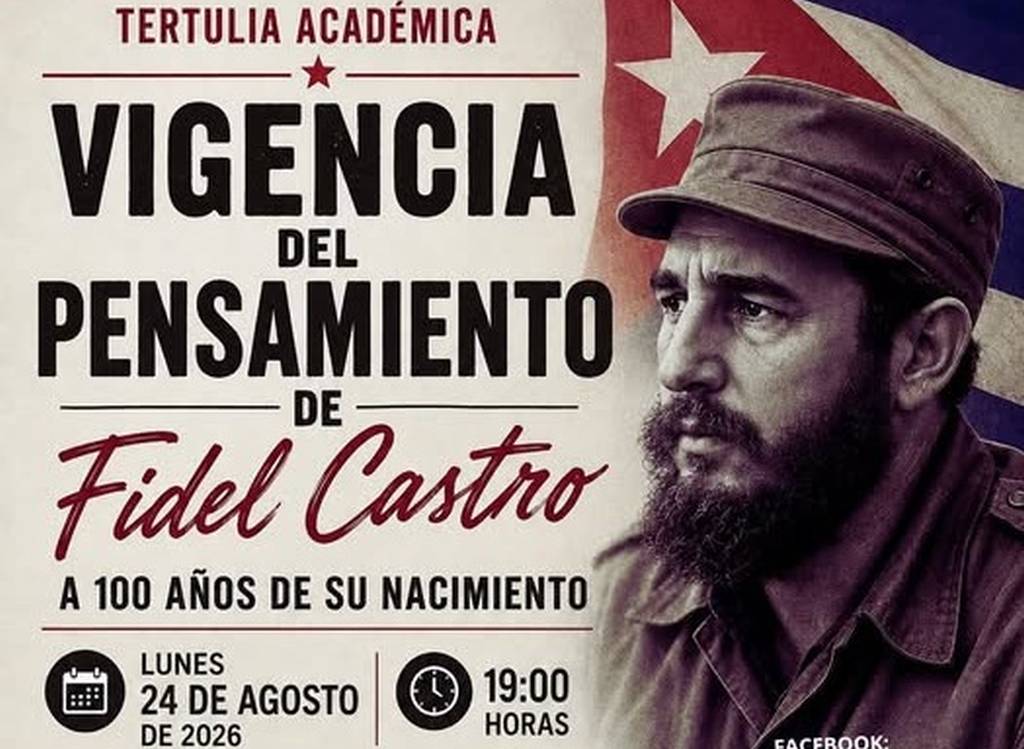
Exponen desde Guatemala latido vivo del pensamiento de Fidel Castro
Participants in an academic colloquium from Guatemala to assess the relevance of Fidel Castro's political thought expressed that the Cuban revolutionary leader continues to beat alive today in the face of current processes and scenarios.
Amid a certain discouragement, fragmentation, and violent disorganization of Latin American society by U.S. imperialism, the Commander in Chief remains relevant, underscored senior researcher Jaime Alberto Chicas.
Sociologist Carlos Figueroa highlighted different moments of the Antillean strategist, such as his speech at the climate summit held in Rio de Janeiro, Brazil, in 1992, in which he spoke about a species in extinction as a result of global warming and pollution.
In that sense, he noted, Fidel was a pioneer in pointing out what is currently one of the greatest dangers looming over humanity.
He asserted how the Cuban leader had the true wisdom to distinguish the enormous potential of that young Venezuelan military officer named Hugo Chávez, whom he received with full honors in Havana when he was not yet president.
At the gathering, organized by the Institute of Historical, Anthropological, and Archaeological Research of the School of History at the University of San Carlos, Figueroa considered that under Fidel's guidance, Cuba influenced world events.
Journalist Factor Méndez recalled the visit of the Antillean revolutionary to New York for the United Nations General Assembly in September 1960 and his meeting at the Hotel Theresa with Malcolm X, who was part of the welcoming committee in Harlem.
Cuba's ambassador to Guatemala, Nazario Fernández, thanked the speakers and affirmed that the world is living through a stage in which the battle of ideas is fundamental.
"It is very difficult to face the current moment if there is no clarity in the values being defended, in a political program that results in the satisfaction of the needs of the masses," the diplomat elaborated.
He returned to 1959, to a Cuban nation with high levels of illiteracy, insecurity, unemployment, and an exploited peasantry.
"Undoubtedly, the Revolution could not have triumphed, much less developed socially, if it had not been for the consciousness that the people acquired under Fidel's leadership," the official specified.
"This constitutes an important element, especially in the current moment, in which we face adversaries who do not have a shred of scruples, who try to impose peace through force," he noted.
The ambassador described it as fundamental that Fidel's thought, his way of facing circumstances and adversities without ever surrendering, be known. He suggested that spaces like this one be held more frequently and reach more people.
Add new comment