
Elections and Extremism in the US
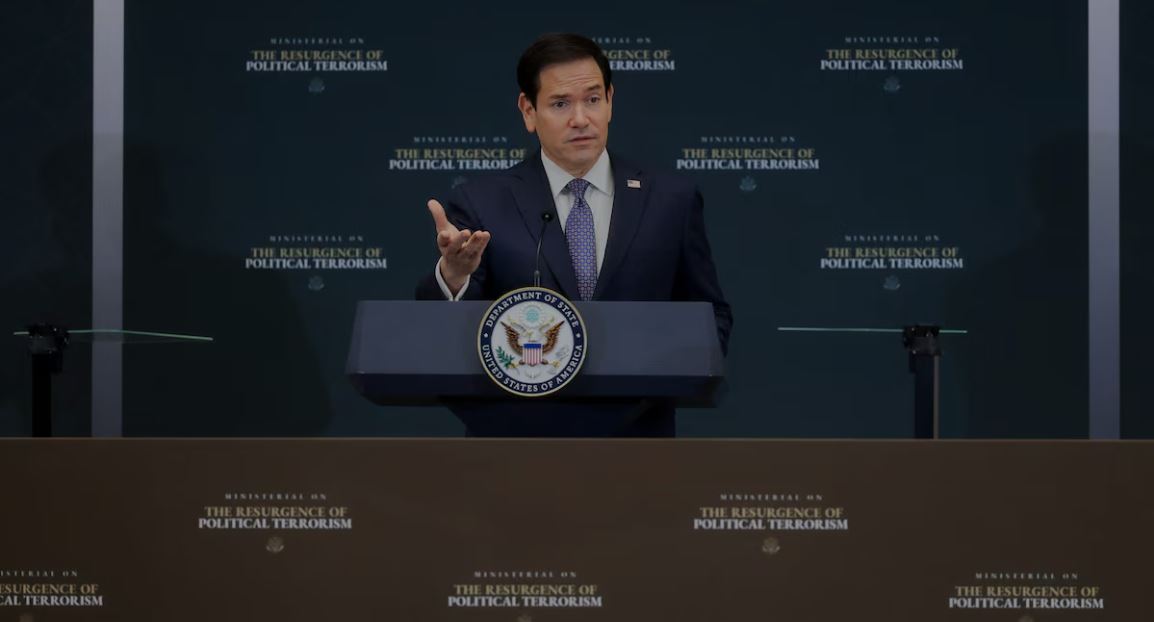
Image: Marco Rubio presides over a ministerial meeting.
In the history of the US, a pattern of behavior can be observed among its leaders, which can be described as follows: faced with adversity, deterioration, or a loss of internal support, they resort to extreme positions; following this same perverse logic, the problems they face, far from dissipating or being resolved, worsen and contribute to or precipitate their political defeat.
For example, what happened during the short “reign” of Lyndon B. Johnson, who, seeking to match the popularity and legitimacy of the assassinated President Kennedy, massively escalated the invasion of Vietnam, contributing to what’s described as one of the most serious quagmires and humanitarian disasters in imperial history.
In a similar manner, one could place Richard Nixon, who was caught up in the Watergate scandal when domestic espionage operations were discovered at the headquarters of the opposition Democratic Party. Far from rectifying the situation, he ordered increased surveillance and attacks against his critics, ultimately leading to his resignation.
Similar situations could be identified with the Ronald Reagan administration, following the political crisis generated by the Iran-Contra affair, that is, when he secretly sold weapons to the Iranians, despite considering them the number one enemy of the United States. Faced with such a scandal, Reagan intensified his anti-communist rhetoric, invoking countless Soviet and Cuban specters and threats, presented as an existential threat to the country. This garnered support from conservative sectors, but ultimately weakened him, revealing the risks of such covert policies.
The case of the Bush son administration is often rightly presented as a failure in many respects, including those mentioned here. The final straw was its invasion of Iraq after the September 11 terrorist attacks; that invention of weapons of mass destruction and the chaos generated in the invaded country marked the decline of international trust in the United States. This drift, along with the 2008 financial crisis, partly explains why the American people elected—if one can accept this term in the country's "democratic" system—the first Black president, and "worse," with a surname that suggests Muslim origins.
At this point, it becomes practically obvious, without much reflection, how the described pattern is playing out in the case of President Trump's second term. The elderly president embodies, amplified and on steroids, all or nearly all of the aforementioned characteristics that invariably led to the political downfall of his predecessors.
First, Trump takes office with a severely damaged reputation; in other words, they even have to grant him a kind of license to govern, an individual with over 30 open legal cases, one of which has already resulted in a conviction. But, well, that's the kind of "ethical luxury" politics offers in the Empire. Underlying this is what is now known as "the tragedy of the Einstein files" (https://www.google.com/search?client=firefox-b-&hs=j1Iq&sca_esv=6e56e9acc9a000dc&q=Joffrey+Einstein&spell=1&sa=X&ved=2ahUKEwi444zu1-aVAxUg4skDHYQdF88QkeECKAB6BAgQEAE) . Undoubtedly, Trump surpasses his predecessors in terms of public disrepute.
Having established the amorality of President Trump, another similarity can be seen, this time with Johnson, with a touch of Reagan. Indeed, it’s clearly evident in the current war against the Persians, who appear once again, but more powerful than ever, defeating the empire with an asymmetrical and heroic defense that has halted the "most powerful" army in the world. In short, Vietnam/Iran and the curse of stalemate.
Thus, the international stage also exponentially mirrors the challenges faced by some of the aforementioned leaders. The war against Iran has amply revealed the isolation of the US, its proverbial subordination to the Zionist entity, which has become a criminal and fanatical structure, and the almost generalized loss of the prestige the US once enjoyed, now surpassed by that of China, according to international polls published by specialized US organizations.
And then there are the internal socio-economic and political difficulties that condition the electoral prospects against Trumpism this coming November. This point warrants a lengthy analysis and, in fact, serves to compare the situation with that of the other leaders mentioned, with the difference that they, in general, did not face the impressive collapse of credibility in the national political system.
Although Trump inherits a legacy of accumulated structural problems, it can be argued that he is the very embodiment of imperial decline, something he represents without equal. The calamitous reality of the middle class, the loss of prestige of the rigged methods of American-style democracy, and the economic impact of the stalemate in the Persian Gulf create an unmanageable cocktail, even for the super-Donald himself.
If this weren't enough, in this already tense political climate, exacerbated by the brazen corruption of the Trump family, The questioning of the plutocracy stands out, due to the shameless and widely publicized level of wealth concentration, which is generating growing public outrage and has become a key issue in the electoral debate—something quite unusual in American politics.
Given this situation, the Trump operation and its MAGA slogan are clearly not working. The president's manipulative skills, the very reason he was elected by this plutocracy, are not proving effective, nor is his ability to deceive the frustrated middle class. Nor is the reactionary narrative, which mixes religion with the absurd notion of returning the country to the 19th century, sufficient. In other words, the ruling party's electoral command center believes they need to escalate their ultra-right-wing rhetoric.
In this context, the Nazi-fascist drift of official discourse in Washington becomes clearer. McCarthyist, ultra-conservative, obscurantist, and other similar epithets are being used these days to describe the elderly president's speeches when he alludes to the enemies to be defeated this coming November. In any case, this challenge—the electoral one—undoubtedly takes absolute priority, driving all other decisions, policies, and everything else that Trumpism comes up with.
And it is within this context that the rhetorical elaborations and official documents emanating from Mr. Rubio's offices must also be interpreted. Anything the man says, even if it doesn't seem so at first glance, is always firmly subordinate to and intertwined with the electoral process, and directed against the domestic adversary whose very likely and overwhelming victory in November must be stopped.
Naturally, Mr. Rubio, being who he is, adds the Cuban Revolution to the list of victims of the system, or rather, of Trumpism. To this end, he schizophrenically mixes an acknowledgment of his defensive capabilities with accusations taken out of context and exaggerations, as could be seen in the "anti-communist coven," as the Granma newspaper called the meeting of ghost hunters on July 16, or in the most recent document, intended to explain to the ignorant why Cuba constitutes a threat to the "well-being of the American people," more or less.
Mr. Rubio, true to his customary inclination to lie or manipulate reality to suit the dangerous fantasies of his boss, the aspiring emperor, proposes lumping together anyone who opposes Trump into a single category for surveillance/neutralization, and, of course, in compliance with the mandate of the Miami mafia, he emphasizes the danger of "communist Castroism" and its "sinister" intelligence service.
In the hackneyed document, Mr. Rubio accuses the Cuban Revolution of precisely the atrocities that they, the imperialists, have committed against the Cuban people for almost seven decades. Terrorism with more than 5,000 victims, the introduction of plagues and diseases, assassination plots against Cuban leaders, the downing of a civilian airliner, the blockade in practically all its forms, and a long and grim list of other crimes. To top it all off, the document laments that Cuba spies on the US, at which point it loses whatever little interest it so painstakingly tries to generate. Mr. Rubio has just rewritten history—if you'll pardon the irony—regarding the existence of the CIA and its peculiar and "beneficial" activities in Cuba.
The incredible thing about this nefarious chapter in Mr. Rubio's misdeeds against the Cubans is that they didn't even employ a natural, purely human, intelligence to draft their absurd accusatory document against the Cuban nation. It has been verified, using AI tools, that the document in question was likely created/written by an AI (CLAUDE, apparently). What must the intellectual capacity be like at the State Department, that they go to such extremes? Or perhaps the document was so absurdly perverse that no one dared to write it for Secretary Rubio. Someday the truth will come out.
And most dangerously, Mr. Rubio's or CLAUDE's document attempts to demonstrate why a small island, which they claim is a failed state, represents a threat to the powerful empire, overflowing with wealth and military resources. Perverse and ridiculous at the same time.
Note the similarities with previous leaders, especially one of the most aggressive, namely Reagan, who also resorted to visceral anti-communism to corner opponents. With Trump and Rubio, everything is certainly much worse, because they have far more sophisticated and effective tools for surveillance, blackmail, and sanctions, supported by so-called techno-feudalism, which boasts of its contempt for the majority of human beings.
It must be emphasized that the entire situation points to an impact on the results of an election that Trump considers lost, hence his dusting off his old conspiracy theory about the theft of the 2020 election, seeking to discredit the established electoral system. Certainly, the matter shows that it's not about conservative ideas or anything like that; it's the panic of a clique of super-mega-hyper-millionaires who feel their control is slipping away, and as already pointed out, the Trump "experiment" has been a pathetic political disaster.
The distinguished intellectual Umberto Eco summarized in 14 points how to recognize fascism. For example, any “disagreement is treason,” “criticism ceases to be legitimate and becomes a threat,” diversity (religious, ethnic, or cultural) “transforms into danger,” there are appeals to the frustration of “the middle classes,” an “obsession with the existence of a conspiracy,” and one of the most relevant: “the enemy is simultaneously powerful and decadent,” paradoxically appearing “invincible and at the same time a failure or miserable.” And all this is nuanced with the use of what Eco calls “impoverished language or Neolanguage.” In other words, the Trumpian universe.
History is usually unforgiving to those who repeat the same mistakes, seeking different results, as is the case with the current “strategy” of Trumpism and its outdated anti-left; at best, they will be able to consolidate an idiotic electoral base, which seems to be shrinking, in step with the “damned” reality and a veritable record of broken promises. electoral.
If the system works and is respected, these elections would reasonably pave the way for the premature fall of the government that includes Mr. Rubio. The situation is very serious; and if the world was already grappling with right-wing extremism, in the American electoral arena, under the conditions described, this phenomenon will very likely be exacerbated. Even figures of pure conservative lineage, like journalist Tucker Carlson, consider that what is happening now is the closest thing to the prelude to a civil war in the country. Let's hope Carlson is wrong; the American people, the first victims of the decaying empire, do not deserve this fate.
In short, this is how the dialectic of political history works, and in the case of the current situation, Trumpism seems to show once again how the cure is worse than the disease. It has happened before. Considerations are welcome, especially after the second Tuesday of November.
Translated by Amilkal Labañino / CubaSí Translation Staff
Add new comment