
Díaz-Canel: "As Long as There Are Classrooms with Students in Cuba, and Schools with Teachers, There Is a Nation, There Is a Homeland, There Is a Revolution, and There Is Socialism"
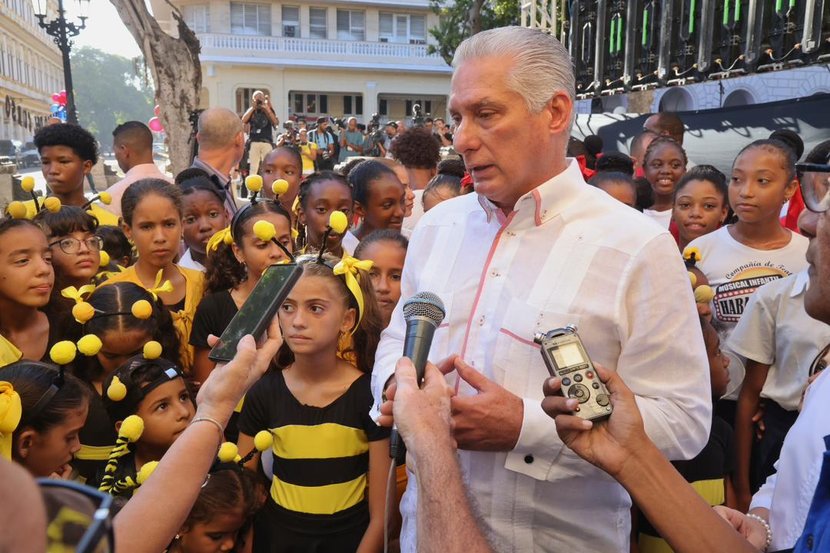
Foto: Estudios Revolución
A Victory in the Classrooms
"As long as there are classrooms with students in Cuba, and schools with teachers, there is a nation, there is a homeland, there is a Revolution, and there is Socialism." Thus reaffirmed Miguel Díaz-Canel Bermúdez, First Secretary of the Central Committee of the Communist Party of Cuba and President of the Republic, on Tuesday morning following the National Central Ceremony for the start of the 2026–2027 academic year.
From the iconic Paseo del Prado in Old Havana—a setting that holds traces of the school where the teacher Mendive formed a young José Martí—President Díaz-Canel spoke to the press team of the Presidency of the Republic of Cuba, taking note of the emotion inspired as the country opens its classrooms: "Starting this school year was, for all of us, a tremendous commitment."
He shared that thought because, in his view, it meant "starting the school year during the centenary of the birth of the Commander in Chief, amid the situation we are currently living through."
Surrounded by children, adolescents, and young people who had taken part in an event marked by beauty and emotion, the dignitary shared three essential reflections with reporters, first pointing to "the victory that is present today in Cuban classrooms with the beginning of this school year."
A second element, he noted, relates to "the fruit of a collective effort." And a third element, he said, "is the challenge we face to teach and to learn" while actively engaged in ongoing transformations.
"The triumph is in the classrooms," stated the Head of State, "because, as the Minister (of Education, Naima Ariatne Trujillo Barreto) explained, this has not been the sound of a routine bell nor an ordinary bell."
"It is having started the school year amid a complex situation that we cannot deny—neither to our teachers, nor to our students, nor to our children, nor to our adolescents."
Díaz-Canel Bermúdez highlighted that launching the present academic year "is also demonstrating the capacity of a country, of a nation, of a Revolution, where the passion for knowledge and love for the Homeland prevail over all restrictions, prevailing over that genocidal policy of blockade" which aims, he denounced, to drag a country into barbarism.
Beginning this school year, the Cuban President emphasized, "is a response to the colonizing barbarism they try to impose on us. It is the will of a people, of a Revolution. It is political will. It is pedagogical will. It is the nation's determination that knowledge and the passion to learn will rise above any adversity."
"And I believe that when this is achieved, and when this triumph is won in the classrooms under the conditions in which it has been done, it also demonstrates the stature and height of a people and a nation."
Fruit of a Collective Effort
The President spoke of the fruit born from collective effort: "We have seen weeks of intense work, where all the leadership structures of Education and training organizations—from the grassroots, from the schools, up to the national level—have participated alongside families, the community, all institutions, and Central State Administrative Bodies, as well as provincial and municipal agencies, trying to improve schools and create conditions amidst these adversities."
In the Head of State's opinion, this demonstrates "how we all contribute to education, and how we all defend education." He recounted to journalists how, a few months ago, he had asked the heads of Education and Higher Education, alongside other ministers of training entities, to design how the academic year could be approached despite energy shortages and the intensification of the blockade, without ever considering canceling the term.
In this regard, he stated: "I knew I was giving them a very difficult task. I never doubted, but I always wondered what options could be put forward."
"And I think after two weeks they presented the first proposal for the school terms; it was a truly innovative, truly creative proposal." Díaz-Canel Bermúdez stressed that this type of response under such adverse conditions could only be generated by "commitment and trust in the Revolution."
For this reason, and for "this effort by everyone that has allowed us the fruit of starting the school year," the Head of State affirmed: "It is worthwhile to extend our gratitude and recognition to all our teachers, professors, institutions, parents, families, and communities for what has been accomplished."
"And a third topic, then, is the challenge of how we teach and how we learn in times of transformation. Because it is not just about starting the term: it is about starting the term and defending, amidst complexity, the quality of education."
The Cuban President told reporters: "I say even more: what we have all planned together, what we have set out to do, is that in such a difficult school year, we are going to push for even higher quality in education."
"Every classroom will become a workshop for solutions. It will be a difficult school year, but it will be a dignified school year."
"This beginning of the school year is an embrace of optimism and an expression of the decision held by the Revolution and the country to continue defending a social conquest as sublime and paradigmatic as the nation itself is for all of us. It is giving our children, our grandchildren, our youth, and our children the right to be educated; and it is also giving them the right to dream so that we can share those dreams."
A Call to Teachers, Students, and Families
The First Secretary of the Central Committee of the Communist Party of Cuba issued a call first to teachers, of whom he said: "We know they also face the complexities of daily life within their own households, that their salary is not what we would like it to be, nor does it fully compensate all their effort."
To them, Díaz-Canel Bermúdez sent this message: "May they be aware that they are the backbone, alongside our creators and artists, of this people's cultural resistance; that we need their capacity for innovation; we also need their dedication, their commitment, and their embrace of children who may be in situations of greater vulnerability."
"Because they," the President said regarding teachers, "are not merely transmitters of knowledge: our teachers, professors, and teaching staff are above all builders of the resilience that distinguishes us as a nation and as a people."
To the youth and students, the President expressed: "May you be aware that all this effort was made for you, that this entire collective effort was carried out for you. Therefore, there is no justification for a lack of educational or pedagogical resources to serve as an excuse not to learn."
"On the contrary: dedicate yourselves with passion to studying, dedicate yourselves with passion to learning, and let that also be part of your contribution to this daily effort and to the great effort the entire country has made so that the school year could begin today."
To Cuban families, the dignitary emphasized that "the school alone cannot do it" and that, together between school and family, "we have to contribute" and "we have to defend this work."
Toward the end of his remarks, Díaz-Canel Bermúdez extended a message to Cuban society: "Happy start to the school year, and we wish everyone success in it."
Not Just Any Bell Rings
The National Central Ceremony for the start of the 2026–2027 school year opened by remembering Fidel Castro and proved moving from start to finish: filled with art, music, dance, and the talent of children, adolescents, and young people. It was a beginning capable of bringing tears to one's eyes, serving as evidence that against all odds, the island reopens its classrooms to sow knowledge and values in its youth.
It was a beautiful morning near the sea, attended also by Politburo member and Prime Minister Manuel Marrero Cruz, as well as other leaders from the Communist Party, the Government, the Young Communist League, mass and student organizations, training entities, and other institutions supporting the education sector.
The main address was delivered by Naima Ariatne Trujillo Barreto, who stated: "Once again it is September, and as on every first day of the ninth month of the year, the Cuban School reopens its doors. The sun that rises and illuminates classrooms, courtyards, and institutions on this date announces a new beginning, revealing the excitement of our children's arrival, the firm yet gentle step of the teachers, and the urgent, hopeful stride of families."
"So it has been for every generation, enjoying the conquest that has given us identity and that the world recognizes as the great work of the Revolution."
Naima highlighted that "the bell calling us today sounds different. It is not merely the ringing of a bell, the signal from a loudspeaker, or the firm call of a teacher inviting the start: it is the heartbeat of a nation that decides, once again, to bet on its future. It is the sound of resistance, tenderness, and hope. It is heard with the strength of those who know that educating is the noest and most just thing we can do."
The Minister emphasized that "education in Cuba is not negotiable. It is not measured in new blackboards or flawless uniforms, though we will fight every day, every moment, to have them." She stated this because "education in Cuba is measured in the dignity of not abandoning anyone," and "it is measured in the certainty that even if a resource is lacking, there will be an abundance of creativity, solidarity, and love from our teaching corps."
Naima spoke of Fidel as inspiration, evoking "one of the most momentous events for Cuban educators and for all our people: that epic campaign that forever changed the face of Cuba, the 1961 Literacy Campaign." She reflected that, 65 years later, "we face new challenges, but the spirit and determination remain the same."
The Minister stressed that "the great challenge of this school year and our greatest victory will be making every day of learning sustainable." She underscored that this term "is conceived around flexibility and individualized responses. Every school, territory, and community has its own conditions and possibilities, which is why decisions will be made locally."
To the teachers preparing for the new term, the Minister expressed gratitude for their heroism, while asking families for trust and participation. Likewise, she extended a message to the student body:
"We tell you that this school year will be a challenge, but also an opportunity. Know that your smiles, your curiosity, and your desire to learn are the primary reason for our effort."
Add new comment