
Cuban President Visits Electric Vehicle Factory in Boyeros
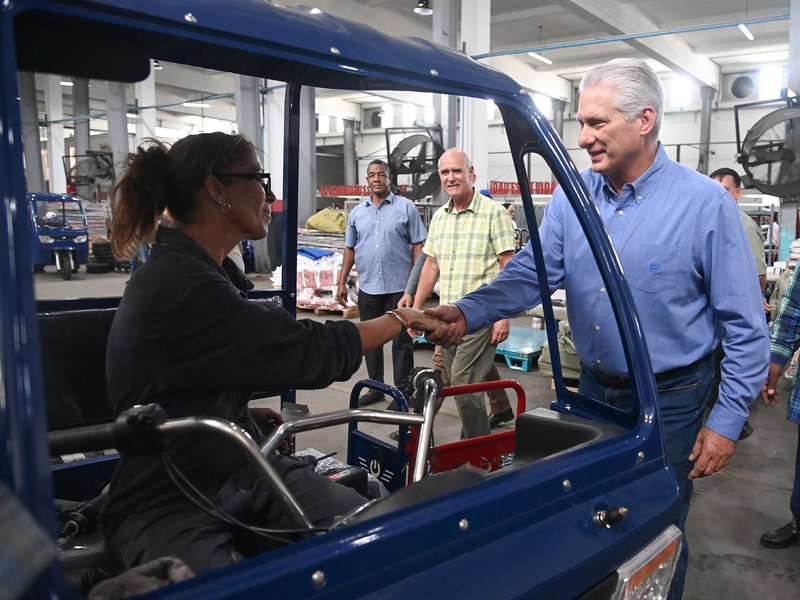
Visita Presidente cubano fábrica de vehículos eléctricos en Boyeros
Miguel Díaz-Canel Bermúdez, First Secretary of the Communist Party of Cuba's Central Committee and President of the Republic, visited today the International Economic Association “Vehículos Eléctricos del Caribe” (VEDCA), located in the Havana municipality of Boyeros, where he described the factory as a bastion of cooperation with the People's Republic of China and a concrete expression of the shared future community between both nations.
During the tour of the assembly plant, the president spoke with workers and managers of the company, which in 2025 generated more than $12 million in revenue and produced 10,000 units.
Julio Oscar Pérez Pérez, director of VEDCA, explained that the company has three main product lines: electric bicycles, electric motorcycles, and electric tricycles, and plans to incorporate electric cars in the second half of this year, with a range of between 200 and 250 kilometers and a speed of 80 to 90 kilometers per hour, according to the Presidency's official website.
“This factory must be a factory that stands out at the national level; that distinguishes itself; that is an innovative factory, contributing to development,” Díaz-Canel said, emphasizing that the entity is linked to the energy transition that Cuba is promoting as one of the country's strategic priorities, alongside defense and food production.
The President highlighted the importance of electric mobility within that transition and called on workers to become champions of the use of Renewable Energy Sources (FRE) to power all processes. He noted that the company can be a modern, flexible, innovative, and therefore competitive organization, setting an example of the efficient and socialist State Enterprise we aspire to have.
The Chinese ambassador to Cuba, Hua Xin, present during the visit alongside Minister of Industries Eloy Álvarez Martínez, recalled that Friday marked two years in his post on the island and emphasized that Cuba has become an example in terms of energy transition and the use of FRE.
“China will not change its determination to support Cuba in this transition,” the diplomat stated.
Julio Oscar Pérez Pérez detailed that the company, born from a partnership agreement between the Chinese company Tianjin Dongxing and the Cuban company Minerva, began operating in 2021 and has advanced year after year, increasing production levels.
In the first year, they managed to produce just over 1,000 units, and in 2025 they reached 10,000. The executive announced that this year they are planning much higher sales levels and aspire to transform their management model to create a joint venture, which would emerge with a metal structure production line to manufacture tricycle frames in Cuba.
Regarding commercialization, he explained they have two main channels: international payment gateways and retail store chains. This year, they have already sold over 1,000 bicycles and motorcycles to the Foreign Currency Collection Stores (TRD), and they plan to create mixed TRD-VEDCA stores in Havana, Villa Clara, Santiago de Cuba, and Holguín.
The director stressed that demand is so high they cannot meet it fully, but they are addressing part of the population's needs.
Regarding energy sustainability, Pérez Pérez reported that they have already made the socio-administrative building energy-independent with a photovoltaic system that covers all electricity needs, and they have an approved project to achieve total independence from the National Electroenergetic System (SEN) by August or September. Furthermore, all tricycles produced from now on will incorporate a photovoltaic panel.
At the end of the visit, Díaz-Canel announced he would repeat the visit before the end of the year. “It is very encouraging to visit places like this, in such difficult times,” the president said, because, in his view, there “you breathe development and combativeness.”
Add new comment