
Cuban President Evaluates Progress of Community Youth Network
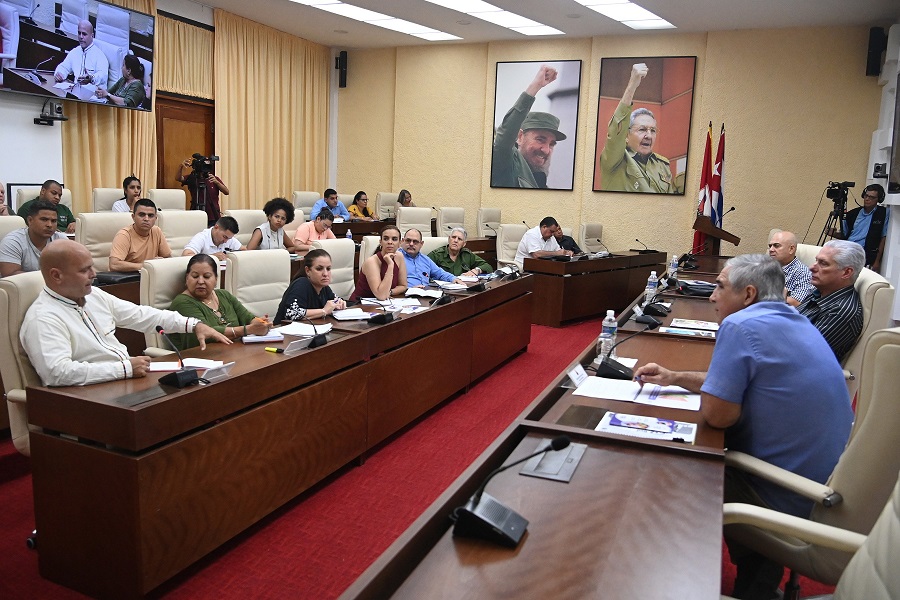
Foto: Estudios Revolución
The President of Cuba, Miguel Díaz-Canel, evaluated the progress of the implementation of the Community Youth Network during a meeting with youth and student leaders, according to a report by the newspaper Granma today.
Meyvis Estévez, the first secretary of the National Committee of the Young Communist League (UJC), reported that 135 municipal-level meetings have been conducted during these first four weeks of work. She noted that establishing strategic alliances with every ministry remains a priority for the network’s success.
Estévez also highlighted the importance of each "popular council" (local government ward) being "adopted" or sponsored by a specific enterprise, alongside the ongoing development of diagnostics to identify primary community issues.
In this context, Díaz-Canel recalled the core tasks proposed in March, which include:
National defense and the energy battle.
Food production and economic development.
Communication, popular mobilization, and ideological formation.
Solidarity, cultural creativity, and the "battle of symbols."
"In every location, there is something to beautify; there is an institution to improve," the President stated. He underscored that without a clear map of a community's specific problems, it will be difficult to achieve tangible results, asserting that the energy of the youth will bring a new "rhythm of work" to the community stage.
Yaliel Cobo, second secretary of the UJC, emphasized the formative value of community service, while Danhiz Díaz Pereira, president of the Martí Youth Movement, explained that the strategy follows the principle of accompanying and supporting existing local structures within each popular council.
Major General José Antonio Carrillo, president of the Association of Combatants of the Cuban Revolution (ACRC), outlined two key premises for the network's success: universal participation and ensuring that actions taken in each community reflect what the community actually wants.
Furthermore, Gerardo Hernández, national coordinator of the Committees for the Defense of the Revolution (CDR), highlighted the immense potential of mobilized youth working alongside community actors and entities to ensure services and projects function more effectively.
Díaz-Canel concluded by insisting on the systematic maintenance of these exchanges to ensure that no problem concerning daily life remains exempt from analysis.
Add new comment