
Cuban Foreign Minister: "The U.S. Is Trying for Collapse, But They Will Not Succeed"
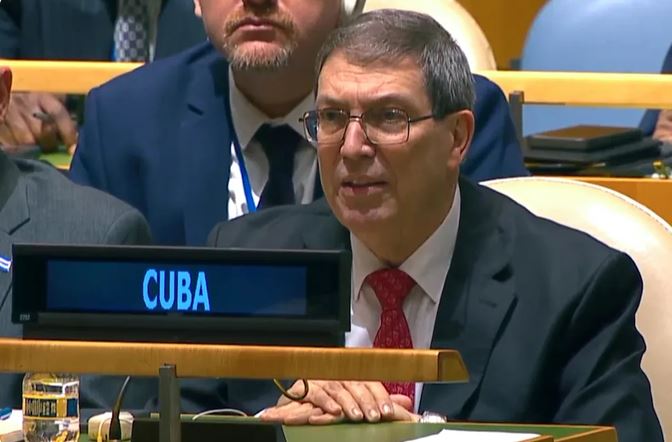
Cuban Foreign Minister Bruno Rodríguez Parrilla defined in his intervention the siege to which the U.S. government subjects the Caribbean nation as a deliberate strategy to achieve social collapse in Cuba.
Before the United Nations General Assembly, Cuba's top diplomat assured, however, that they will not succeed, and that this is thanks to the work deployed by the country, which has been blamed for the impacts caused by the siege policy, and to the support of international solidarity.
"Cuba demands that they leave it in peace," he demanded, and then recalled: "Cuba is not a threat, the blockade is."
Rodríguez Parrilla responded to the phrase "This is America" pronounced yesterday by the U.S. representative and maintained that this approach reflects a worldview that treats and considers the planet as if it were part of U.S. territory.
Faced with that assertion, the diplomat stressed: "This is the United Nations. It is the capital of multilateralism. It is the capital of an international order that should be based on international law and the Charter of the United Nations."
He also vindicated the General Assembly as the most universal and democratic body of the organization.
Rodríguez Parrilla noted that the U.S. representative's phrase does not constitute a lapse or a simple conceptual error, but rather expresses an underlying vision: that of those who look at Cuba and the other member states as if they were something close to one of the 50 states of the Union.
In that sense, he affirmed that this perspective is the basis of the concept of "peace through strength," that is, of the imposition of peace through force.
Faced with this, he was categorical: "Cuba is not a threat. The blockade is."
Along these lines, the diplomat condemned the provocative action the previous day by the U.S. representation, which went to film without consent toward Cuba's seat, which provoked an altercation that culminated in a request for the expulsion of a Cuban official who represented an important candidacy of the island to one of the multilateral bodies.
Likewise, he denounced the presence in the hall of a declared terrorist, a common criminal, financed by Washington and sought by Cuban law in clear violation of the principles and the premises of the UN.
"It constitutes a lack of respect for the victims of terrorism and of 9/11 for him to be present in this hall," he stated.
Regarding the human impacts of this policy, he warned that "no people deserves the abuse and suffering that is being imposed on us today."
The representative of the largest of the Antilles noted that the matter even extends to children who have been deprived of the right to exist, alluding to the increase reported in the country in infant mortality by more than five points.
Rodríguez Parrilla questioned Washington's denialist discourse that speaks of not accessing medicines and products because of the government's management, when it is the blockade itself that prevents access to specific treatments that are only produced in the U.S.
He mentioned that at the same time these limitations deprive the U.S. public of benefiting from the advances of Cuban biotechnology.
Likewise, he referred to a second phrase pronounced yesterday by the U.S. representative: "The blockade against Cuba does not exist," and contrasted it with the reality that, he denounced, the Cuban people suffer.
In that framework, he explained that every minute of procedural delay and every minute of deliberations implies extraordinary damage to the population, damage that, he said, cannot be measured by the clock in the hall.
To illustrate that assertion, he asked the webcast to zoom in and showed a counter that, he indicated, marks the damage of the blockade against Cuba since the beginning of the previous day's session, counted at current prices in U.S. dollars.
According to that tool, since the session began the damage of the blockade was equivalent to more than 22.9 million dollars.
He denounced that "since July the aggression has acquired a new and stark dimension" with the U.S. government's efforts to "hinder, obstruct and sabotage" the program of economic and social transformations that Cuba "has sovereignly charted for itself."
Rodríguez Parrilla warned that, despite the economic war, Cuba will not cease "in this endeavor for the well-being and dignity of Cubans."
The foreign minister directly quoted the U.S. Secretary of State, who on August 7 would have said: "what we are trying to make them understand is that there is no escape valve; every time they create a new mechanism to try to free themselves from the rope of the gallows, we will simply tighten it more."
He maintained that the most manipulated pretext by Washington is to present Cuba as "an alleged threat to the nuclear superpower or even to the hemisphere," a fallacy that, he affirmed, "no government represented here admits or accepts."
Faced with those accusations, the foreign minister stressed that "far from constituting a threat, Cuba has contributed to that country's national security priorities."
Add new comment