
Cuba Will Prevail
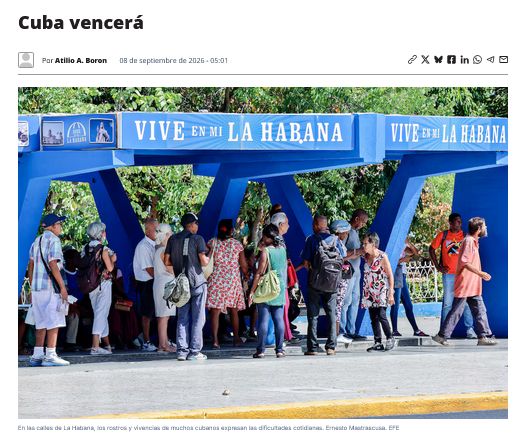
As days go by, the Trumpist autocracy in the United States persists in its criminal policy of tightening the blockade against Cuba. Regrettably, it does so amidst the indifference of the so-called “international community”—which, were it truly such, ought to have reacted immediately by demanding—and securing—an end to that policy.
This indifference is shared by the vassals of the United States: the vast majority of European governments and the European Union (whose top figures, Ursula von der Leyen and Kaja Kallas, are bureaucrats intoxicated by their hatred of Russia and of all peoples who resist the imperial dictatorship—of which they are unconditional henchmen). It is shared, too, by Canada, Japan, and Korea.
In short, looking beyond geography, we see that core—in an advanced state of decay—known as the so-called “collective West” and its institutions, all mired in irreparable bankruptcy. There is passivity and complicity—not only regarding the aggression suffered by Cuba, but also evidenced by their scandalous callousness toward the genocide of the Palestinian people (as well as those in Lebanon, Syria, and the West Bank) perpetrated by the Israeli Zionist regime, not to mention its perpetual aggression against Iran and the Houthis in Yemen.
Ultimately, the entire imperial order has collapsed as a result of the slow yet inexorable rot of its moral foundations, laying bare its rapacity, its economic interests, and the monstrous image of the imperial Leviathan—personified by that semi-senile megalomaniac inhabiting the White House who believes himself, or pretends to be, the master of the world.
In Asia, his grumbling is heard, but without significant practical consequences. In Africa, he goes unheard. Having fallen out with his European lackeys, he has reduced the nations of that region to non-entities in the realm of international politics. Trump wants to act but no longer can; this infuriates him and fuels his aggression. Yet his presence still looms large in "Our America," even if it no longer inspires the fear or submission it once commanded elsewhere in the world.
Milei’s Argentina presents a unique case of groveling subservience—a scenario that defies generalization. The madman in the Casa Rosada—once a fierce proponent of the "self-determination" of the Malvinas' inhabitants (arguing they should "vote with their feet" regarding whether or not to belong to Argentina)—now speaks of an "implanted population" that cannot override the principle of territorial integrity enshrined by the United Nations and long defended by Argentina.
Moreover, no one believes what Milei says; he is a buffoon—nothing more than an expendable tool that Trump will use and then discard in his bid to renegotiate British funding for NATO. While not true of every country in the region, a quiet rebellion against Trump’s arrogance is brewing in several of them. Depending on the nature of the government in power, the level of organization among the popular movements, and the depth of past anti-imperialist consciousness-raising, this rebellion may or may not spark unexpected popular reactions. I firmly believe that there are more anti-imperialist peoples than anti-imperialist governments in Latin America and the Caribbean, and I also believe that this equation is destined, at some point, to be reversed. To pick up the thread of our argument: in this global context, we must call for effective worldwide solidarity with Cuba—not merely solidarity expressed in words or rhetoric, but concrete support translated into material aid. This aid is essential to help the world’s most solidary nation survive the gale-force winds of the blockade. We need more governments with the audacity to defy the empire’s orders—not only for Cuba’s sake but in their own self-interest—to prevent an unleashed Leviathan from laying waste to everything.
If we could get just four or five of them to organize a convoy of oil tankers carrying humanitarian aid to Cuba, Washington would be forced to do what it has already done several times under Trump: swallow its threats. Let’s hope such governments step forward. For the time being—and for tactical reasons—I prefer not to publicly call upon them to undertake this mission. But that is only "for the time being," as Chávez used to say.
I conclude by expressing my admiration for the remarkable resilience of the Cuban people and government as they confront endless difficulties, deprivations, and setbacks of every kind. These struggles are magnificently portrayed in the beautiful song *Un abrazo en medio del vendaval* (An Embrace Amidst the Gale) by María Isabel Perdigón Gutiérrez, which I would like to share with you.
Cuba is resisting and will continue to resist, paying an exorbitant price—just as it did during its nineteenth-century struggle for independence from Spanish rule. Yet it will do so time and again, driven by national honor and courage, and by its status as the worthy heir to Martí and Fidel. The path is hard, and may become harder still, but I have full confidence that this island—indispensable to those of us who desire a better world—will emerge victorious in the face of this challenge: a blockade that stands as the most criminal ever endured by any people in human history, and a source of eternal disgrace for the United States.
Translated by Amilkal Labañino / CubaSí Translation Staff
Add new comment