
That Colony Called Palestine
The United States—led by Trump, acting as a Horseman of the Apocalypse—has urged Israel to clear away the rubble of what it devastated in Gaza. However, Palestinian forces have refused to allow this, as the site holds the remains of some 8,000 people killed by Tel Aviv’s aggression—the worst episode in a series of ongoing Zionist attacks that have claimed over 100,000 lives.
The US president’s attempts to turn the mass grave of tens of thousands of Palestinians into a tourist attraction—devoid of Palestinians—have met rejection from millions of people. Regrettably, these people have found themselves powerless to halt the genocide perpetrated by Zionist Prime Minister Benjamin Netanyahu, with the backing of his American protector.
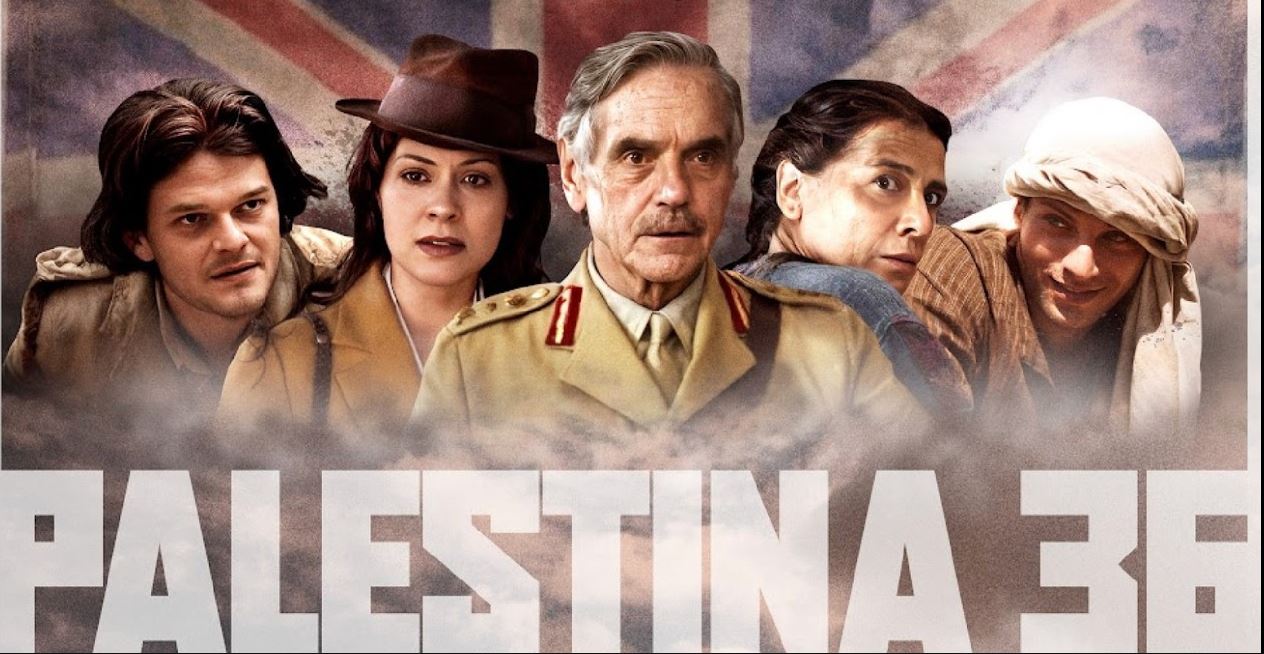
The genocide in Gaza has sparked massive protests, solidarity campaigns, and growing challenges to the official Israeli narrative and Western complicity. Yet, it’s striking that a film screened at numerous international festivals and honored with major awards has not—at least so far—contributed to opening a broader public debate on the political and historical roots of the Palestinian question.
The film’s reach seems largely confined to cultural, intellectual, and activist circles already attuned to the issue. In this context—and taking up some of the questions raised by the film itself—it may be worth revisiting the origins of this story. For, beyond its devastating humanitarian consequences, we are facing a conflict that is political in nature, ...and any real solution necessarily requires understanding how it was constructed.
PALESTINE 1936
In 1936, Palestine was under the British Mandate and maintained a diverse society composed of Muslim, Christian, and Jewish communities that had shared the territory for generations. That religious plurality was also present in the revolt—an aspect the film successfully captures. The problem was—and remains—political and colonial in nature.
Since the Balfour Declaration of 1917, which was subsequently incorporated into the Mandate itself, Great Britain had backed the creation of a "national home for the Jewish people" in Palestine. Under that colonial protection, the Zionist project of settling European Jews through land purchases and transfers took hold, fostering a growing awareness among the Palestinian population of territorial dispossession and the loss of sovereignty. Resistance had been building for years, and the death of Izzedin al-Qassam in combat in 1935 became a symbol of that process. Those tensions would ultimately erupt into a revolution with a strong peasant base.
The revolt began in 1936. In April, the Arab Higher Committee was formed to coordinate protests that rapidly took on a national scale; over the following six months, there were strikes, civil disobedience campaigns, tax refusals, boycotts, and acts of sabotage. Thousands of Palestinians participated, particularly those from rural areas directly affected by the loss of land.
Yet that national mobilization was also marked by class contradictions. The film clearly illustrates the gap between the working classes—who bore the immediate brunt of dispossession—and certain urban elites, whose interests could find room for accommodation or even collaboration with the colonial administration. The struggle against British rule and the Zionist project thus coexisted with a class struggle within Palestinian society itself—a weakness that, in various forms, would persist in its political life for decades.
After an initial phase dominated by strikes and civil mobilization, the revolt took on an increasingly insurgent character from 1937 onwards. Palestinian forces went so far as to contest effective control of the territory, dominating vast mountainous areas and certain cities until 1939.
Confronting them was a large-scale British counter-insurgency apparatus, which relied also on auxiliary forces and the collaboration of armed Zionist organizations. The Haganah—which would later form the core of the Israel Defense Forces—cooperated with British authorities, and some of its members participated in units involved in operations and reprisals against Palestinian villages; the Irgun—led years later by Menachem Begin, founder of Herut and a direct precursor to Netanyahu’s current Likud party—stepped up attacks and retaliatory actions against the Arab population starting in 1937.
The Great Revolt thus stands as a major precursor to the later Intifadas and highlights a fundamental point for understanding the present: Palestinian resistance and the conflict over land, sovereignty, and self-determination predate the creation of the State of Israel by more than a decade.
British colonial rhetoric reduced these events to mere "disturbances," obscuring their true scale: a national, anti-colonial uprising against a political order imposed from the outside and against the colonization process unfolding under British oversight.
British repression combined collective punishment, the destruction of homes, and operations against villages accused of collaborating with the revolution. Concurrently, in 1937, the Peel Commission proposed the partition of Palestine: the future Jewish state was to receive approximately one-third of the territory, even though land acquired under the Zionist settlement project amounted to barely 5.6%. Moreover, nearly half the population in that area was Arab, placing population displacement at the very heart of the project from the outset. The defeat of the revolt left Palestinian society weakened, disarmed, and politically fragmented, while Zionist organizations emerged strengthened.
However, the White Paper, published on May 17, 1939, reflected a new balance of power. The Great Revolt had demonstrated the enormous cost of maintaining that colonial order indefinitely through force; at the same time, the international landscape was hurtling toward a new world war, which would begin just three and a half months later. London needed to protect its strategic interests in West Asia and prevent the Palestinian rebellion from fueling broader hostility across the Arab world.
Great Britain subsequently limited Jewish immigration, restricted land transfers, and proposed the creation of an independent Palestinian state. This international shift had another consequence: as London sought to mend relations with the Arab world, the Zionist movement increasingly looked to the United States for its primary external support. After the war, it was Truman who would pressure Great Britain to allow the entry of 100,000 Jewish refugees into Palestine.
UNFINISHED DECOLONIZATION
Looking back at 1936 allows us to understand the Palestinian question as a process of unfinished decolonization. The film reminds us that the current tragedy is rooted in specific political decisions and specific Western responsibilities.
Yet this shift was not a natural progression; rather, it was the result of the mass persecution of European Jews. Their departure from Europe cannot be interpreted as a widespread embrace of Zionist ideology: it was Nazism, Fascism, and ultimately the Holocaust that turned hundreds of thousands of Europeans into refugees, stripping them of their rights, property, and homes. In fact, among those who managed to escape Germany and Austria before the war, a larger proportion headed to the United States and Latin America than to Palestine.
Nevertheless, that tragedy provided the Zionist project with new demographic and political momentum, as Western powers—reluctant to open their own borders—accepted Palestine as a destination for the Jews expelled from Europe. The contradiction is hard to ignore: European racism turned them into foreigners in their own lands, while the consequences of that persecution ended up being shifted onto Palestine.
Looking back at 1936 allows us to understand the Palestinian question as an unfinished process of decolonization. The film reminds us that the current tragedy is rooted in specific political decisions and in equally specific Western responsibilities.
Zionism established itself as a project that served the strategic interests of Western powers—first Great Britain and later the United States—which found a useful instrument in settler colonialism to maintain its influence over a crucial region. Understanding this political dimension is essential if we are to stop addressing the Palestinian issue only when its consequences take the form of a new humanitarian crisis.
A real solution requires understanding the root causes, the power dynamics, and the colonial nature of the problem, and establishing the conditions for Palestine to finally be decolonized.
Translated by Amilkal Labañino / CubaSí Translation Staff
Add new comment