
Colombian Presidential Elections: Petro and Cepeda Question Far-Right Candidate's Victory
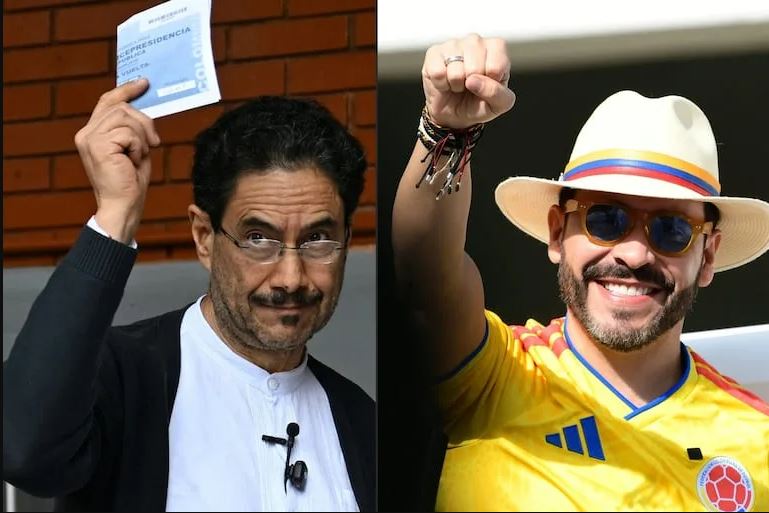
The far-right candidate Abelardo de la Espriella has declared victory in Colombia by less than one percentage point in the preliminary count, while President Gustavo Petro and the ruling party candidate Iván Cepeda denounce irregularities and ask that the public wait for official results, which, according to unofficial sources, will be released next Thursday.
With nearly 26 million votes split between the two candidates and a difference of less than 1%, the country is divided into two blocs of very similar size.
Therefore, while the lawyer's supporters are already celebrating a historic victory for the far right, the government insists that the decisive step remains: the official count, which, precinct by precinct and vote by vote, must confirm whether Abelardo de la Espriella will truly become the next president of Colombia.
The lawyer, an admirer of Trump and with no political experience, leads the government's candidate, Iván Cepeda, by a mere 245,000 votes. The presumed winner received the open support of the US president and his main admirer, Congresswoman María Elvira Salazar, of unfortunate Cuban origin. The first congratulatory message came, as expected, from his partner in the Miami political machine, now Trump's foreign minister, Marco Rubio.
With 99.65% of the polling stations counted in the preliminary tally by the National Registry, De la Espriella had obtained 12,931,544 votes, equivalent to 49.65% of the total, compared to the 12,684,994 votes obtained by the government-backed candidate, Iván Cepeda, who reached 48.70%.
The difference between the two was a mere 245,738 votes, less than one percentage point, a much narrower margin than most polls and analysts had predicted during the election campaign.
The close race has led neither candidate to rush to declare the final result. While De la Espriella declared himself the winner, Cepeda urged caution, and Petro went further by publicly denouncing irregularities in the process.
"The polling stations without the signatures of the poll workers must be challenged immediately. It's still impossible to know who the president is, and there are many irregularities," the Colombian president wrote on social media.
Petro asserted that there are electoral forms that appear to have been submitted without the corresponding signatures and reiterated that the preliminary count is for informational purposes only. He insisted that the official count, conducted by thousands of judges and notaries throughout the country, will determine who will ultimately occupy the Casa de Nariño (Presidential Palace) for the 2026-2030 term.
The winner—barring any unforeseen circumstances—in his first address after the results were announced, called for national unity and promised to govern for all Colombians. "From this moment on, the electoral campaign, the divisions, and the political confrontations end," De la Espriella declared to thousands of supporters gathered in front of the Ventana al Mundo (Window to the World) monument in Barranquilla, where he gave his first speech after receiving the results and claimed his victory as the beginning of a new era for the country.
The 47-year-old lawyer and businessman asserted that there would be no "winners or losers" and promised to assume the presidency on August 7th as a symbol of national unity: "I will be the president of all Colombians."
"Based on this feeling that we are beginning a new era, a new stage, I tell you: I am a man trained in the law, respectful of the branches of power, of Congress, and the high courts. Mine will be an absolutely democratic government, a guarantor of freedom and the rule of law," De la Espriella stated.
Abelardo de la Espriella, 47, founded the Defenders of the Homeland movement just eleven months ago with a clear objective: to prevent the left from remaining in power after Gustavo Petro's term.
With no prior experience in public office, he built his entire campaign around an idea he constantly repeated: precisely because he had not been part of the traditional political class was his main asset.
Known for years as a criminal lawyer and businessman, De la Espriella presents himself as a self-made leader, an avowed admirer of Donald Trump, and ideologically close to figures like Argentine President Javier Milei and Salvadoran President Nayib Bukele.
His discourse has been based on promises of a tough stance against crime, a fight against corruption, a reduction in the size of the state, and the country's economic transformation. During the campaign, he asserted that he would turn Colombia into a "miracle nation," citing growth models like Ireland and South Korea as examples.
A CONTROVERSIAL FIGURE
The Bogotá lawyer's figure is not without controversy. Before entering politics, he built a successful professional career defending clients with enormous media impact. Among them was David Murcia Guzmán, the central figure in one of Colombia's biggest financial scandals.
He also participated two decades ago in initiatives related to peace processes with paramilitary groups. His detractors also criticize him for statements considered sexist and a highly polarizing political style, while his supporters value precisely his direct language and his outsider image.
The provisional victory De la Espriella's victory was quickly celebrated by leaders of the international right.
One of the first to react was the president of Vox, Santiago Abascal, who publicly congratulated the Colombian candidate and asserted that the citizens had said "enough to the narco-socialism of Petro and his successors."
"Freedom, order, truth, and the sovereignty of nations are making their way forward with force in Latin America," the Spanish leader wrote on the social network X. De la Espriella himself responded, claiming that he had managed to prevail "over the vote-buying, the corruption, and the same old faces."
CONSIDERATION
If it materializes, the victory of the far-right candidate further closes the path for the peoples of the region to the subservient allies of Trump.
De la Espriella is ashamed of his social origins. He strives to project an image of opulence, a lawyer who respects the law, someone well-liked by the governments of the United States, Argentina, and El Salvador—the complete opposite of his true nature. He comes from humble origins, born into a family on the Caribbean coast who, under paramilitary control, ended up becoming involved with those groups and serving as their lawyer.
Now, since the first round of voting, he no longer wants to dismantle the state, he's no longer an enemy of a living wage, he no longer threatens to disembowel his opponents live on air. But his essence remains the same: authoritarian, a friend of violence, and opposed to the rule of law and the Constitution.
With his likely victory, representative democracy is threatened—because it’s not participatory democracy, as he himself has clearly stated: he will trample over the institutions. The social gains of recent years are under threat, as are the principles of the social rule of law, nature, the páramos (high-altitude Andean ecosystems), biodiversity hotspots, women's rights, and the rights of the LGBTQ+ community. All of this can be summarized in the principles of a society that calls itself democratic.
Add new comment