
Brawl with Milei
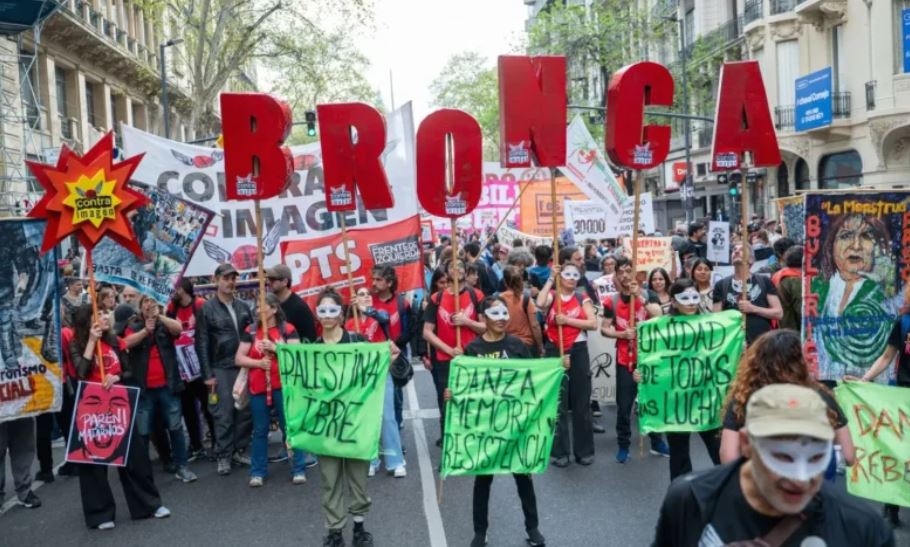
This is the name of the massive popular protests that have taken place in Buenos Aires and 60 other Argentine cities against the policies undertaken by the long-haired libertarian president, which are impoverishing the majority of the population and enriching the already well-placed economic elites who, together with Washington, support the far-right.
Debts, closures and protests: pressure on Argentine households and companies grows as Milei defends his policies, which cast doubt on his ambitious plans to be re-elected to the presidency in 2027, stimulated by the continued division of an opposition sickened by personal leadership ambitions.
An economic crisis that is suffocating thousands of Argentine homes and companies made the capital's Plaza de Mayo once again become the usual epicenter of political and social mobilizations in the country, concentrated on two demands linked by the same concern: the growing difficulty of families and small business owners to sustain their activity and make ends meet.
On the one hand, business owners and small and medium-sized businesses mobilized on the occasion of Entrepreneur's Day to denounce the closure of thousands of businesses since the inauguration of President Javier Milei, in December 2023. On the other hand, unions and social organizations participated in the so-called “March of the Debtors”, focused on the increase in household debt.
The mobilizations occurred while the president gave an extensive speech in Buenos Aires to representatives of the business and financial world, within the framework of the annual meeting of the Council of the Americas.
The deterioration of the businesses appears as one of the main arguments of the protesters. According to a report by the Fundar think tank, cited by the EFE news agency, since Milei took power, 30,633 companies have been lost, equivalent to 6% of the total.
The data, prepared with information up to May 2026, also shows that 2,371 companies closed that month, an average of 76 companies per day. Fundar considers that this is the worst fall recorded during the first 30 months of a Government.
The Center for Argentine Political Economy (CEPA) agrees with the figure of 30,633 missing companies and places commerce as the most affected sector, with 8,408 fewer businesses. They are followed by transportation and storage, with 6,733; real estate services, with 4,098; and the manufacturing industry, with 4,020.
Some 5.8 million Argentines are considered in default, that is, more than 90 days late in paying their bank debt, according to the Central Bank. Half are on the bad debt list. "Indebted Organized" is a group of affected citizens that takes to the streets to demand solutions. In recent years, Argentina's credit quality and that of households have evolved in opposite directions, according to official figures and independent entities.
"We are not saying 'I don't have enough to buy pants'. The reality is that I don't have enough to eat, I don't have enough to feed my children," Noelia Manrique, a mother who heads the household in the city of Pilar, in the province of Buenos Aires, told the AFP agency. Like Noelia, millions of Argentines have had to access credit to meet their immediate needs.
In June, according to Céndea (Central Debtors), which is the public database of the Central Bank, there were 20.96 million debtors in the country, out of a population of 46 million. Some 5.91 million are in default.
The president of the Bank of the Province of Buenos Aires, Juan Cuatreño, told AFP that "the growth in delinquencies is not a consequence of individual decisions, it’s the result of a macroeconomic context that has deteriorated income, employment and economic activity."
For President Javier Milei, however, the problem is "an agreement between private parties." Furthermore, he told the right-wing newspaper La Nación, in a mocking tone: "Did they put a gun to their heads to do it?"
In short, Milei's economic plan is reconfiguring the country at two speeds: while large megaprojects celebrate billions in investments, historical sectors such as factories and commerce face company closures and job losses, which increases the social gap.
ANGER AND HOPE
"It's anger but also hope, that, based on the struggle, the organization, all these union, social, and human rights organizations that we conquered, we will be able to build something different, democratic from below," said Myriam Bregman, deputy of the Left Front and one of the organizers.
Bregman, the main speaker of the day, denounced the defunding of universities, public health and culture. She also asked the labor unions to call a general strike "to defeat Milei and his entire plan."
"We also denounce the extractivism that hands over territories, water and common goods to corporations. Polluting mega-mining, fracking, land clearing and agribusiness leave disease and environmental destruction while producing enormous private profits," Bregman said from the stage.
The workers of the FATE tire factory also appeared, who have been fighting for several months against the closure of the plant and layoffs.
The march, which, as we already noted, had its largest demonstration in Buenos Aires, was replicated in 60 other cities in Argentina, such as Córdoba, Rosario and Tucumán.
In total, according to organizers, there were more than 350 political and social groups that joined, although there were also many families and ordinary citizens.
During the central event, a joint document was read criticizing the Government's economic program, the "complicity" of the provincial governors and the inaction of the country's main labor confederations, the General Labor Central (CGT) and the Argentine Workers' Central (CTA).
Translated by Amilkal Labañino / CubaSí Translation Staff
Add new comment