
Bolivia: Rodrigo Paz Enacts Law Legitimizing Repression Through Armed Forces
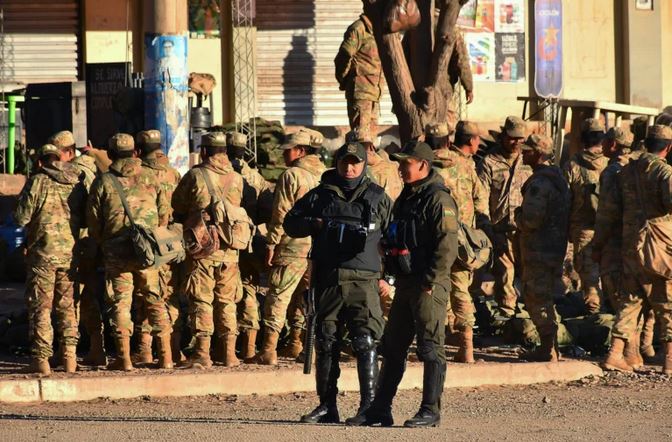
A través de esta ley el presidente Rodrigo Paz puede declarar estado de excepción, no solo para reprimir las manifestaciones sino además para intentar desmovilizar a quienes piden que renuncie. Foto: EFE
Bolivia’s President Rodrigo Paz promulgated Law 1732 on Wednesday, which abrogates Law 1341 on States of Exception. The measure gives him free rein to legitimize the repression of the Bolivian people’s massive mobilizations, which for four weeks have demanded his resignation and maintained blockades in various regions of the country.
The law, already published in the Official Gazette, was approved by more than two-thirds of the Senate and 66 percent of votes in the Chamber of Deputies. With this promulgation, Paz has a clear path to decree states of exception without the limiting requirements that were in place until now, especially in the context of protests demanding his resignation.
The new law completely repeals Law 1341 on ‘States of Exception,’ which had been in effect since October 2020 and established limitations on the participation of the Armed Forces in response to social protests.
Through the new law, President Rodrigo Paz can declare a state of exception, not only to repress demonstrations but also to try to demobilize those calling for his resignation.
Among the main limitations that Law 1341 imposed on the executive branch was the condition that the Armed Forces could only intervene when the capacity of the police was clearly overwhelmed. Additionally, it established that neither the Armed Forces nor the police would be exempt from criminal liability or enjoy impunity for their actions. This law was crucial to preventing excesses and ensuring accountability in emergency situations.
Law 1341 arose from a report by the Interdisciplinary Group of Independent Experts (GIEI), which after an investigation determined that massacres occurred following the 2019 coup against Evo Morales in Senkata, Sacaba, Huayllani, and El Pedregal, resulting in approximately 37 deaths.
The Paz government, which has been in office for just over six months, has stated that declaring a state of exception is the “last option” it will resort to if dialogue does not progress.
On Wednesday, the president warned: “The vote is respected, and the Constitution is too. That’s just how it is; those are the rules of the game. But if they do not want to dialogue, that’s what the constitutional rules are for. I want to be very clear.”
Demonstrations and Blockades
The demonstrations and road blockades, which began in the department of La Paz, are driven mainly by peasant unions, the Bolivian Workers’ Central (COB), sectors aligned with former president Evo Morales (2006–2019), as well as members of the El Alto Neighborhood Federation, miners, Ponchos Rojos peasants, factory workers, teachers, and guild merchants.
During the fourth week of mobilizations called by the Bolivian Workers’ Central, the number of road blockades rose to 150 deployed across six regions of the country.
The organizations demand the resignation of Rodrigo Paz, in addition to rejecting his government’s privatization plan and the austerity measures that affect Bolivia’s most vulnerable sectors.
The Bolivian Workers’ Central has opened the possibility of dialoguing with the government under two conditions: the release of those detained in the clashes of recent days and the suspension of the arrest warrant against the organization’s executive, Mario Argollo, and other union leaders.
Add new comment