
The Barbados Bombing: Half a Century of Remembrance Against Impunity
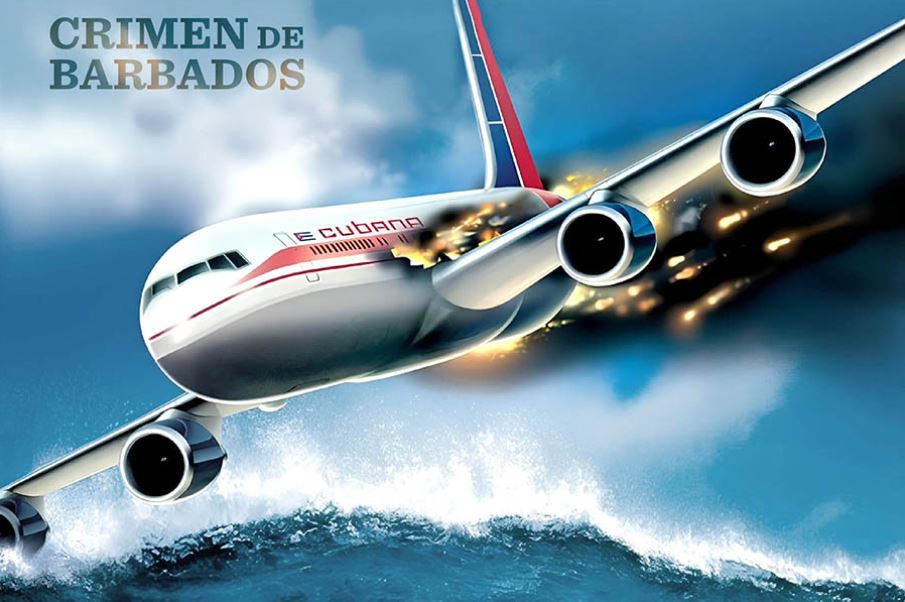
Fifty years ago, on October 6, 1976, Cubana de Aviación Flight CU-455 took off from Seawell Airport in Bridgetown, Barbados, bound for Jamaica and Havana. It carried 73 people: 57 Cubans, 11 Guyanese, and five citizens of the Democratic People's Republic of Korea.
Among the passengers were 24 young Cuban fencers returning victorious, having won every gold medal at the Central American and Caribbean Championships.
They carried no weapons, nor hatred. They carried the happy exhaustion of competition, photographs of their triumph, and, perhaps, the pure eagerness to embrace their loved ones once more.
Shortly after takeoff, two bombs exploded inside the plane. The Douglas DC-8 turned into a ball of fire over the sea, and in just a few minutes, 73 personal stories were reduced to names, photographs, uniforms, passports, and questions.
On board were athletes just beginning to discover the magnitude of their dreams, as well as workers, students, crew members, and families of various nationalities. Terrorism made no distinctions; it killed them all alike, as if death could erase borders—and innocence, too.
But death could not erase their faces. The young fencers remained forever young in Cuba’s memory, frozen at the age they were that day. Empty chairs and rooms suspended in time were left behind in their homes, along with medals unable to console parents who would never hear their children’s voices again.
Each anniversary reopens the same wound: that of those who waited for a plane that never arrived, and of those who learned that a sporting triumph could be transformed—by the criminal hand of hatred—into a time of national mourning.
The crime was neither a matter of chance nor the result of a storm. It was designed, planned, and executed. Investigations and testimonies gathered over the years identified the masterminds as Cuban-born terrorists Orlando Bosch Ávila and Luis Posada Carriles, both linked to the Coordination of United Revolutionary Organizations (CORU).
Venezuelans Freddy Lugo and Hernán Ricardo Lozano were responsible for planting the explosives, while Pablo Gustavo Castillo Díaz—known as "El Cojo" (The Lame One)—studied Cuban flight routes and helped select the aircraft.
These names must not be confused or allowed to fade into the mists of time: those who conceived the murder, those who sought the means to carry it out, and those who planted the bombs were all part of the same criminal chain.
It was neither a freak accident nor a tragedy without perpetrators. It was a terrorist act against a civilian airliner, against defenseless passengers, and against every human being's fundamental right to return home alive.
Nor can we ignore the shadow cast by those who knew the truth yet remained silent. Declassified documents revealed that the U.S. Central Intelligence Agency (CIA) had been aware of plots to bomb a Cubana de Aviación flight since June 1976 and had received information regarding plans to attack a Cuban plane just days before the explosion. Despite this, no timely warning was issued that might have prevented the tragedy.
History is not written solely with case files, reports, and the names of the guilty. It’s also written in a mother’s silence as she waits by the phone, in the uniform of an athlete who never again broke a sweat on the field, in an empty airplane seat, and in the question that has endured for half a century without finding rest: why were those who orchestrated that massacre able to hide behind impunity?
During the memorial service held on October 15, 1976, in Revolution Square, Commander-in-Chief Fidel Castro spoke from the depths of a nation’s grief: “When a vigorous and virile people weep, injustice trembles.”
It was not merely a phrase uttered before a crowd. It was the transformation of grief into memory, of memory into denunciation, and of denunciation into an unwavering demand for justice.
Cuba remembers the victims of Barbados not to fuel hatred, but to prevent hatred from reappearing under new uniforms, new pretexts, and new flags.
To condemn that crime is to condemn all acts of terrorism—regardless of who commits them, which people they target, or what interests are used to justify them.
No political cause legitimizes the killing of civilians. No alliance can absolve those who plant bombs. No calendar holds right to bury the truth.
Fifty years later, the plane continues to fall within the world's consciousness. It falls every time impunity tries to masquerade as oblivion; every time a murderer is portrayed as a combatant; every time a victim is reduced to a statistic.
Yet the memory of those 73 human beings remains standing, and with it the certainty that the victims of Barbados did not vanish: they live on in their families' demand for justice, in the indignation of a people, and in the responsibility of those who can still call things by their true names.
For the sea may have swallowed the plane, but it could not sink the truth. And as long as a people remembers the names of its dead, the bomb will remain what it was: not merely an explosion lost over the Caribbean, but the blood-stained signature of a crime that, half a century later, still cries out for justice.
Translated by Amilkal Labañino / CubaSí Translation Staff
Add new comment