
Trump Claims Canada Joining EU as "Associate Member" Could Be a "Hostile Act"
Trump amenaza a Canadá con más aranceles tras acusarles de "negligencia" por los incendios
European Commission President Ursula von der Leyen proposed on Wednesday that Canada become the first "associate member" of the bloc, a measure aimed at strengthening their economies in the face of rising trade tensions with the United States.
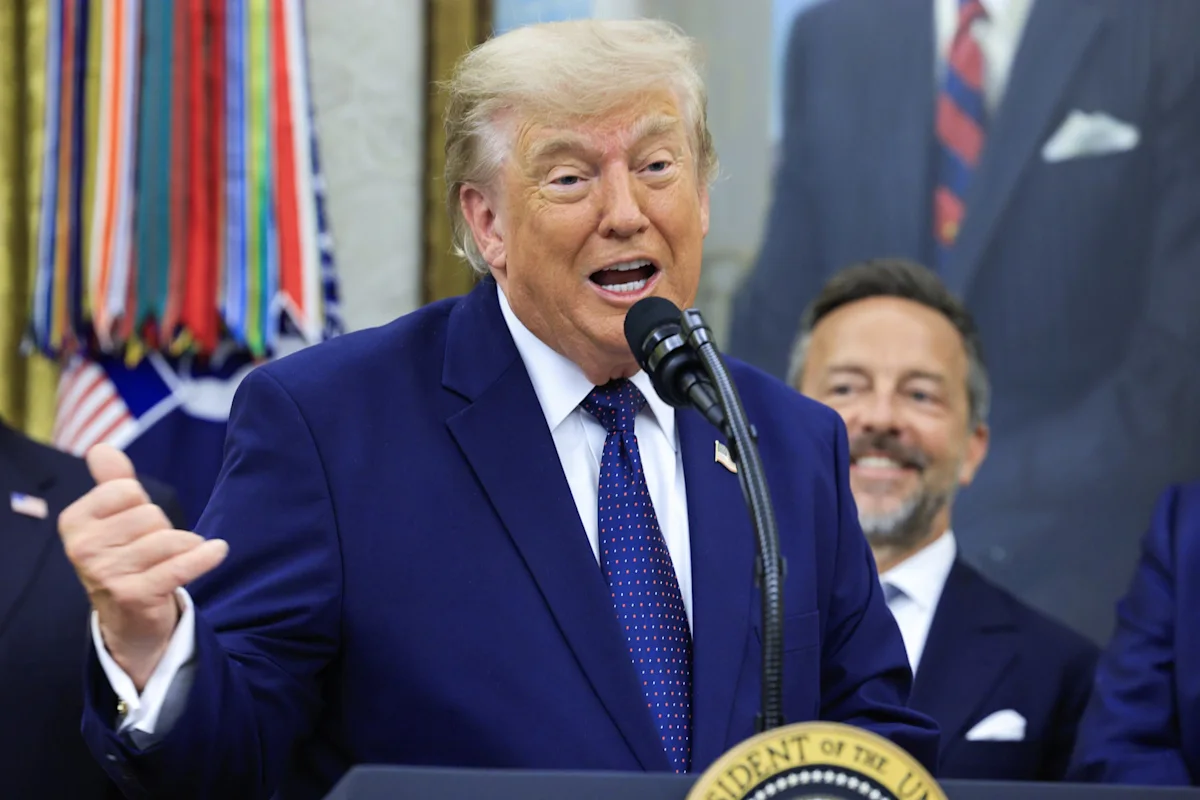
The measure seeks to fortify their economies against escalating commercial friction with the United States. However, Trump declared on Wednesday that the United States could impose heavy tariffs on the European Union if it considers any new agreement with Canada to be a hostile act.
"If the intention is good, fine. If it's bad, we will impose very high tariffs on Europe, which is a possibility," he told reporters.
Canada is currently embroiled in a trade war with the United States, its primary trading partner, which increases the urgency of efforts to forge closer ties with the European Union.
Trump has also repeatedly called for Canada to become the 51st U.S. state, an idea that Canadian Prime Minister Mark Carney categorically rejects.
Carney was invited to von der Leyen's State of the Union address in Strasbourg, France, where he commented that "in this new world we must urgently rethink our alliances and build global coalitions for our resilience and our democracies."
"I would like to work with you to open the door for Canada to be the first associate member of the European Union," Von der Leyen told Canadian Prime Minister Mark Carney, who was attending her State of the Union speech in Strasbourg, France.
"In short, we want to take the relationship with Canada to the highest possible level," she declared.
Canada is currently immersed in a trade war with the United States, its main commercial partner, intensifying efforts to tighten ties with the European Union. U.S. President Donald Trump has also repeatedly insisted that Canada become the 51st state of the United States, an idea that Carney categorically rejects.
Carney received a standing ovation from European lawmakers and is scheduled to address the European Parliament on Thursday.
In her speech, Von der Leyen highlighted plans for cooperation in smart manufacturing, technology, defense, cybersecurity, and artificial intelligence. Likewise, she noted that Canada and the European Union would work together on energy, critical minerals, and batteries.
It remains unclear what other elements associate membership might entail, or whether all EU member states support the idea. Carney, for his part, is pushing the relationship forward, declaring on Sunday that Canada is seeking a "unique alliance with the European Union."
Despite the context, Von der Leyen stressed on Wednesday that the decision to join forces with Canada "is not an alliance against anyone else," although the EU has also been affected by tariffs imposed by U.S. President Donald Trump on his allies over the past year.
Here is what we know about the growing ties between Canada and the EU.
Why Does a Closer Partnership Between Canada and the EU Make Sense?
Canada, a former British colony, shares deep cultural and historical ties with Europe and resembles European models regarding its parliamentary democracy, universal healthcare, and social welfare, among other areas.
Canada even shares a small land border with Europe, through Denmark, on Hans Island—a small landmass off the northwestern coast of Greenland.
While Canada likely meets the political, economic, and legal standards to join the bloc, there is an obvious barrier: geographically, it is not located in Europe.
To join the EU, a country must follow a strict, multi-stage process called accession, and its candidacy must be approved unanimously by all 27 member states.
There is a list of countries waiting to join, and currently nine nations are recognized as candidate countries for EU membership.
Other European nations, such as Norway and Switzerland, are not formal EU members, but they collaborate with the bloc on trade and open borders. Their agreements could serve as a model for tightening ties between the EU and Canada.
What Would a "Unique Alliance" Look Like?
According to a Wall Street Journal report published over the weekend, topics discussed by European and Canadian officials include: reducing trade barriers; laying undersea cables connecting Europe and Canada; rerouting pipelines to give Europe access to Canadian gas; building new technology and artificial intelligence infrastructure; and even granting Canadians the right to live and work in Europe without a visa.
Under these conditions, Canada would have an unprecedented relationship with the EU for a non-European nation. The EU ambassador to Canada told the Canadian Press last week that this partnership would be unlike any other in existence, though without providing specific details.
Details regarding what a potential alliance might look like have not yet been publicly announced. However, there are signs that Canada and the EU are strengthening their ties.
Prior to Carney's speech, the European Parliament announced that it will open a new satellite office in Ottawa, underlining its commitment to "deepen political dialogue and cooperation with Canada," according to a press release.
The allies already maintain a significant trading relationship, which has grown steadily since much of the EU-Canada Comprehensive Economic and Trade Agreement came into effect in 2017. The EU is Canada's second most important trading partner.
Bilateral trade in goods and services reached 130.8 billion euros ($151 billion) last year, according to the European Commission, marking an increase of more than 80% over the past decade. Top EU exports to Canada include automobiles, machinery, and pharmaceuticals. Canadian exports to Europe include crude oil, fertilizers, critical minerals, and base metals.
What Have European Leaders Said?
Carney, former governor of the Bank of England, maintains strong ties in Europe thanks to his career in the banking sector, and has cultivated relationships with like-minded European leaders since becoming prime minister in March 2025.
Last year in Paris, during his first official overseas trip as leader—which, notably, was not to the United States, breaking with modern tradition—Carney described Canada as "the most European of non-European countries."
Since then, several European Union countries have floated the idea of Canada joining the bloc, including Finnish President Alexander Stubb, who once described the possibility as "a match made in heaven."
Stubb and Carney reportedly text each other daily and are known to take advantage of official trips to go for runs or play a game of ice hockey.
In an April interview with CBC News, a CNN news partner, Stubb stated that he can "imagine a much larger EU, and whether Canada is part of it or not is something for Canada to decide," adding that since both countries share similar values, they could "forge a really close strategic partnership."
"Wouldn't it be wonderful if Canada were the 28th state of the European Union instead of the 51st state of the United States?" Stubb asked, according to the Journal.
In March, French Foreign Minister Jean-Noël Barrot raised the idea of Ottawa joining the EU, stating at a conference that "perhaps Canada will join at some point," according to the Canadian Press.
That does not mean all EU leaders support Canada's bid. Ten member states have yet to ratify the trade agreement that Canada and the EU signed in 2016, which eliminated almost all pre-existing tariffs.
How Has the Idea Been Received in Canada?
According to recent data, Canadians are overwhelmingly in favor of strengthening relations with the EU, although support for full membership remains divided.
A survey conducted earlier this month by the Canadian polling firm Abacus Data revealed that around 80% of Canadians believed Canada should deepen cooperation with the EU on foreign policy, defense, and economic priorities, marking a 6% increase from the last time the question was asked in February.
According to the poll, another 56% of respondents stated that Canada has more in common with EU countries than with the United States. Nearly half (49%) stated they would support Canada joining the EU, with stronger support among centrist voters. Pierre Poilievre, leader of the opposition Canadian Conservative Party, called Carney's effort to tighten ties with the EU "out of touch" in a post on X following the report's publication.
"We will never be the 51st state of the US. And we will never be the 28th state of the EU."
Add new comment