
Rubio García, Touring the "Backyard"
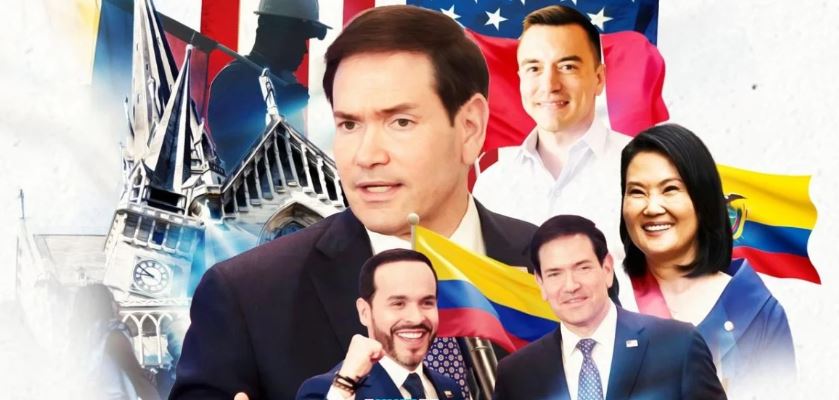
Currently making headlines is the "triumphal" tour of South America by Secretary Marco Antonio Rubio García—the "administrator" of U.S. foreign policy, at least from a bureaucratic standpoint. He visited Colombia (specifically Barranquilla), Quito (Ecuador), and finally Lima (Peru)—the latter two representing, along with Colombia, the State Department's latest political-electoral conquests, achieved with the help of Fernando Cerimedo and the rest of the gang. The iconic—albeit for the worst reasons—concept of the "backyard"—referring to Washington’s disdainful view of Latin American republics—shaped the approach Rubio García took during his visits to the aforementioned countries. He consistently adopted a "Conquistador 2.0" persona, "explaining" how they should govern and how to utilize their national resources. In exchange for obedience, he offered promises of vast resources—promises that were usually impossible to keep, given that, in reality, such support depends on the "mood" of private U.S. investors.
It goes without saying that the primary objective was to hear—directly and on camera—the visited governments express their absolute submission to the empire. The goal was to generate a media splash and allow Rubio García to bask in a spotlight he lacks in Washington.
While this has always been the case, in the current climate, the imperialists themselves openly boast about the true aims of this policy of abject subordination, unencumbered by pretense. In short: securing access to raw materials and vital resources so the empire can maintain its status without competition—forget about free markets or other such "nonsense."
Consequently, a recurring theme—cloaked in half-truths, or rather, "varnished lies"—was the renewed demand to oust the "communist" Chinese from the region once and for all; after all, that is precisely what a "backyard" is for.
The "Chinese nightmare," The major pressures currently destabilizing the State Department—and Washington in general—are, however, highly complex; the scope of the relationships between Latin American republics and the People's Republic of China is so vast and interdependent that even Rubio García can do nothing to neutralize it.
The Cases of Ecuador and Peru
China is now Ecuador's second-largest trading partner; a Free Trade Agreement (FTA) between the two nations has been in effect since May 2024. Between January and May of the current year alone, trade volume totaled approximately $3.102 billion, representing a 32.9% increase compared to the same period in 2025.
Ecuador exports tons of shrimp, cocoa, coffee, flowers, fruit, and timber to China—surplus goods for which they would otherwise lack markets offering such favorable terms.
Notably, President Noboa’s most recent official trip abroad was to Beijing just last month, where he held cordial talks with his counterpart, Xi Jinping; they discussed strengthening trade, investment, and technological cooperation. They also exchanged views on the Asian giant's involvement in the highly strategic Coca Codo Sinclair hydroelectric project.
Regarding Peru, the scale is even greater. China is currently Lima's primary trading partner, accounting for no less than 35% of all Peruvian foreign trade. In 2025, trade volume reached $10.748 billion in exports from Peru, while the country imported approximately $17.847 billion worth of goods from China—primarily technology, machinery, and steel. The legal framework for this flow is established by an FTA and its Optimization Protocol, ratified in July 2026.
In addition to the above, the most relevant and strategically significant element is the emblematic Port of Chancay, a model of Chinese cooperation in the Global South; this port is projected to generate annual profits in the neighborhood of $4.5 billion and is considered the most modern in the entire subcontinent, incorporating 5G and other cutting-edge technologies into its operations. Furthermore, it’s envisioned as the "grand gateway" for Asian trade—particularly from China—into South America, as well as a connecting point for three other maritime routes serving Colombia, Ecuador, Chile, and Panama.
As one can see, the figures are staggering—perhaps even beyond the grasp of the empire. Rubio García, then, essentially went to "pass the hat" and collect payment for services rendered regarding electoral fraud—an endeavor that, frankly, borders on the schizophrenic. On what grounds would South American oligarchies abandon this lucrative bonanza? In exchange for promises of dubious realization? Promises delivered—always with an air of arrogance—by the turbulent and brutal North that holds us in contempt.
Does anyone truly believe that the aforementioned local oligarchies in the countries he visited would make such a massive, multi-billion-dollar shift out of ideological loyalty?
Moreover, do they even profess an ideology that would warrant such a sacrifice? And finally, does anyone trust the US at this stage? This last question is, in fact, likely the one that drives all the others.
In any case, one must give Marco Antonio Rubio García credit for making the effort—an effort that is worth defining more precisely.
First, he brought "interesting" projects to the table—requiring investments of several billion dollars—focused on rare earths and highly coveted minerals. These resources, such as cobalt and lithium, are currently the subject of fierce international competition and are found in the very countries Rubio García visited.
There’s no need to explain the strategic importance of this US bid to secure these resources; as is well known, they form the very heart of its military industry and, more broadly, of everything related to modern electronics—in short, almost everything. And once again, China enters the picture—currently the holder of the world's largest reserves of so-called rare earth elements and a major supplier to the US itself.
Not to rain on Rubio García’s parade, but it seems unlikely he will succeed on this front. We have already seen that ousting China from the "backyard" is impossible, and replacing it in the short term as the primary supplier of these resources to the US is even less likely.
In the process, Rubio García once again brandished the "mighty sword" of the fight against drug trafficking and terrorism, along with "his" Shield of the Americas. There’s nothing new to add, other than to point out that neither the visitor nor his host, Noboa, even mentioned the killing of hundreds of people—many of them fishermen, and a significant number of them Ecuadorian. Everyone knows this is not a remotely viable way to stop the flow of opioids into the US; they ought to start by dismantling their own domestic cartels and stop exporting weapons to Spanish-speaking regions south of the Rio Grande.
Given these impossibilities, it seems rather suspicious the true objectives of Rubio García’s tour—during which he was even presented with a large medallion at a solemn ceremony in Quito by none other than Noboa (Xi Jinping’s friend, if one catches the irony)—.
And why bring this up? Because Rubio García has evidently been relegated to just that: visiting the "backyard," and nothing more. He has been sidelined; the only place he is allowed to meddle is in Spanish- and Portuguese-speaking America. He has no say in the endless war in Iran—he didn't even seem to notice the extraordinary advances made by the Yemeni Houthi rebels, who now control the entire Bab el-Mandeb Strait—and the war in Ukraine is completely off his radar. As for other conflicts—whether created or invented by Trump—involving Canada, NATO, Greenland, or even the planet Jupiter (where the CIA claims a radical left-wing government holds sway), Rubio wouldn't dare stick his oversized ears into such matters.
Someday, an assessment will have to be made regarding the successes and failures of Rubio García’s foreign policy tenure; while comparisons are always tricky, this is likely one of the worst in that country's modern history.
Of course, Rubio García faced a terrible moment and a terrible boss. But the broader context is key: it’s glaringly obvious that the empire’s once-comfortable international hegemony is crumbling. They are defeated in every military adventure they undertake—to the point where they lack sufficient military hardware (projectiles, missiles, etc.). Even their aircraft carriers are no longer effective, as they are vulnerable to sinking—an event that carries far greater symbolic weight than the actual financial cost, given that these vessels represent the long arm of imperial military might.
Viewed in this light, Rubio García’s cruel stance toward Cuba also makes more sense. After all, we know about his ties to the Miami mafia and their ilk; however, in the current climate, there is the added factor of his belief—and aspiration—that he can achieve something regarding that small island just 90 miles away, particularly given what it symbolizes. He seems to think that a "regime change" in Havana—after more than 60 years of unsuccessful attempts—would serve to offset the many other blunders mentioned earlier. From there, he eyes the presidency of the United States; in short, there is a distinct whiff of electioneering in the air.
That is Rubio García’s karma: at the same time, he admits that despite doing everything—even the superhuman—he is making no progress. Worse still, what seems to be gaining traction is the idea that U.S. investors might take control of the Cuban economy without actually ousting "the communists" from power. How is that possible? Ask any of the "strategists" who champion this far-fetched scenario—one unlikely to succeed.
To be clear, the issue is not a rejection of U.S. investment in Cuba; rather, it is the Americans themselves who have been unwilling or unable to invest, due to the draconian laws of the blockade. But there is a long, heroic road between that and actually "controlling" the Cuban economy—a feat beyond their reach.
And calling it "heroic" is no exaggeration; one need only look at the island's population resisting the terrible havoc wreaked by the blockade—which targets energy supplies and extends to other essential needs. In 2026, the blockade resulted in a financial impact of no less than $8.08 billion, with immediate consequences for healthcare, education, power generation, transportation, and a long list of other aspects of daily life for Cubans.
The international community has grasped some of this; the UN Human Rights Commission approved a resolution supporting the UN rapporteur’s report, thereby condemning this genocidal war against Cuba. No one objected—none of its 47 members. Naturally, the U.S. representative was absent, both because the country is not a member of the Commission and because he was reportedly busy blackmailing other delegations to prevent them from supporting the Cuban people's right to live in peace. In short, the envoy of the discredited Secretary of State was completely ignored.
And while Rubio García wandered near the slopes of the imposing and sovereign Andes Mountains, the real world—once subjugated or marginalized by the U.S.—continued on its path, defying it. Mention has already been made of the strategic Houthi victory in Yemen and the unanimous vote in favor of Cuba in Geneva; furthermore, there is the BRICS summit, bringing together the top leaders of India (as host), Russia, China, and other guests to discuss, among other things, how to advance the long-term goal of ending the petrodollar's dominance.
Rubio García ought to understand that he will neither defeat the Cuban Revolution nor succeed in saving imperial dominance in his "backyard" or anywhere else, no matter what he does. As the saying goes in Cuba, the "domino game is bat a stalled,” and it seems Cuba’s chief executioner has ended up holding the double-nine tile.
Translated by Amilkal Labañino / CubaSí Translation Staff
Add new comment