
Noboa, Star of Abjection to the Empire
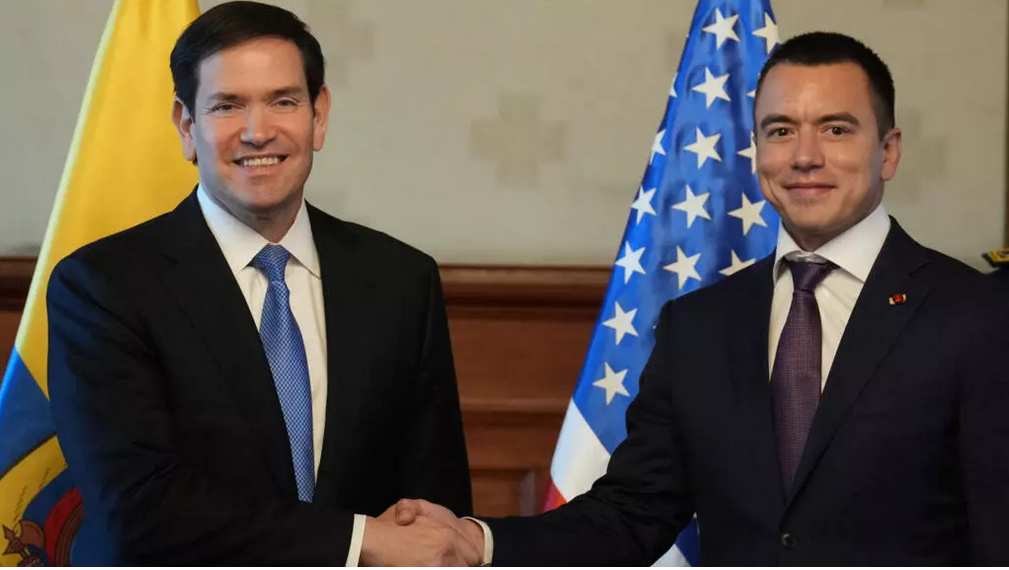
It’s in this context that the most recent terrorist attacks in the department of Cauca, which are not directed against the armed forces but against the civilian population, have occurred. The most recent attack resulted in 22 deaths and 36 injuries, using a gas cylinder and other devices suspected of having been sent from Ecuador. The Ecuadorian regime has declared a virtual economic war against its neighbor and has even bombed a border area, confident in Trump's unwavering support with weapons, soldiers, and intelligence to eliminate governments that do not follow his dictates.
Regarding this, a few hours ago Colombian authorities captured José Alex Vitoncó, alias "Mi Pez" (My Fish), one of those responsible for the criminal attack with the gas cylinder bomb. The arrest took place in the village of Tablones, a rural area of Palmira, in a joint operation by the Police and the Army.
Shortly before, the President of Colombia, Gustavo Petro, had asked the heads of the Armed Forces to investigate whether the explosives used in the department of Cauca came from Ecuador.
"What I want you to investigate is whether the explosives, as my sources tell me they do, come from Ecuador. I hope to look at the one in Cajibío specifically, but in general, the explosives that reach the Cauca fronts of the drug trafficking network come from Ecuador," Petro said in a televised address.
In his address, Petro warned that with attacks like the one in Cauca, drug traffickers seek to sabotage the elections. Presidential elections—the first round of which will take place on May 31—are being orchestrated to ensure a victory for the far right through fear, and he added that this is why armed groups have changed their targets and are now attacking civilians, emphasizing:
"It doesn't surprise me that the groups in Cauca are trying to sabotage the elections. What does the drug cartel want? For the far right to govern Colombia like they do in Ecuador."
Petro's order comes at a time of crisis in relations with Ecuador, which began with the imposition of tariffs on Colombian products ordered by Ecuadorian President Daniel Noboa, who argued that Colombia is not doing enough to combat drug trafficking and other crimes along their shared border.
Colombia responded to the tariff war, which was exacerbated by other differences after Petro labeled former Ecuadorian Vice President Jorge Glas a political prisoner and accused Noboa of letting him starve to death after Glas was kidnapped by police forces during the raid on the Mexican embassy in Quito. This prompted the Mexican government to sever diplomatic relations.
Furthermore, US military personnel are directing local forces in border operations ostensibly against drug trafficking and crime, which has now spread to several provinces of the country. These operations have led to armed clashes, serious harm to the civilian population, and further violence when local military personnel and their US support withdraw from the area.
It's worth remembering that Noboa attempted to amend the Constitution to, among other things, allow the entry of foreign troops. This was overwhelmingly rejected in a popular referendum, but he turned a blind eye to it, as the saying goes.
THE FORMER HAVEN OF PEACE
Even agencies unfriendly to the Correa administration have openly or implicitly acknowledged that the ten-year Citizens' Revolution consolidated Ecuador as a haven of peace in the Andes.
Now it’s the most violent country in South America. This transformation has been dizzying. In 2016, a historic peace agreement in Colombia demobilized the Revolutionary Armed Forces of Colombia, known as the FARC, which were one of the region's largest cocaine suppliers. International drug trafficking organizations, seeking to fill the void, set their sights on Ecuador. The country had it all: geographic proximity to Peru and Colombia, the world's leading cocaine producers, good roads, and deep-water ports that offer an export route to the cocaine markets of the United States and Europe.
These advantages, coupled with state corruption, weak judicial and intelligence institutions, and a collapsing prison system, have placed the country at the center of the global cocaine supply chain. Violent gangs seeking to participate in the business compete for control of trafficking routes and the communities they can coerce and extort, especially along the Pacific coast. Homicide rates, which in 2020 were 7.7 per 100,000 inhabitants, have skyrocketed to around 50, the highest in Latin America.
Since coming to power in 2023, President Daniel Noboa has launched a vigorous military campaign. However, his reliance on the army, coupled with the arrival of U.S. military personnel, has not brought peace. On the contrary, it has unleashed new waves of violence against communities.
In this context, it's important to note that his family, the wealthiest in the country, ships thousands of boxes of bananas abroad, and it has been proven that many of them contain a package of cocaine, a practice that continues with complete impunity.
EVEN MORE SERIOUS
Ecuador's recent history demonstrates that more soldiers—even with a U.S. presence—will not solve the problem.
Ecuador has resorted to its military in previous security crises. In August 2023, President Guillermo Lasso deployed the armed forces during a general election following the assassination of presidential candidate Fernando Villavicencio. But Noboa's use of military force is unusual in its scale and duration.
In January 2024, amid escalating violence—bombings, kidnappings of police officers, prison riots, and an attack on a live television broadcast in Guayaquil—the president declared a state of emergency. This allowed him to deploy the army to combat 22 criminal groups that the government designated as terrorist organizations. He began transferring soldiers to prisons, ordering raids in densely populated neighborhoods, and arresting thousands of people, repeatedly suspending civil rights in the process.
But the killings surged again as Noboa’s repressive strategy unleashed new waves of violence across the country.
In Ecuador’s most vulnerable communities, soldiers do not constantly patrol the streets; often, they limit themselves to carrying out specific operations against criminal groups and their members, and withdraw just as quickly, exposing the civilian population to brutal criminal reprisals. Every arrest or assassination of gang leaders also triggers a struggle for profits and leadership, propelling younger, more ruthless members to rise through the criminal hierarchy.
Last year, Flor de Bastión had two or three gangs; today there are many more, making it nearly impossible to know who controls each block. The security situation in these areas is critical.
For residents of gang-controlled zones, violence has infiltrated daily life. The sound of gunfire is an everyday occurrence. Civilians have to pay exorbitant extortion fees, which strain family budgets and bankrupt small businesses. These payments are a crucial source of income for the gangs, and anyone who refuses or cannot pay faces violent consequences.
The population is losing faith in its supposed protectors because some officers have been coerced or corrupted by the criminal groups they are meant to combat. As a result, police officers are colluding with criminals, focusing their repression on rival gang members. Human rights organizations have documented serious abuses committed by security forces, ranging from torture and sexual violence in prisons to enforced disappearances, arbitrary detentions, and extrajudicial killings. Those who can afford it are fleeing to safer areas.
Many Ecuadorians, both civilians and military personnel, believe that force alone cannot resolve the country's dire situation. Instead, they argue, the country must address the underlying conditions—including the lack of education, employment, and healthcare—that have fueled the wave of crime.
Translated by Amilkal Labañino / CubaSí Translation Staff
Add new comment