
Keiko in a Tight Spot
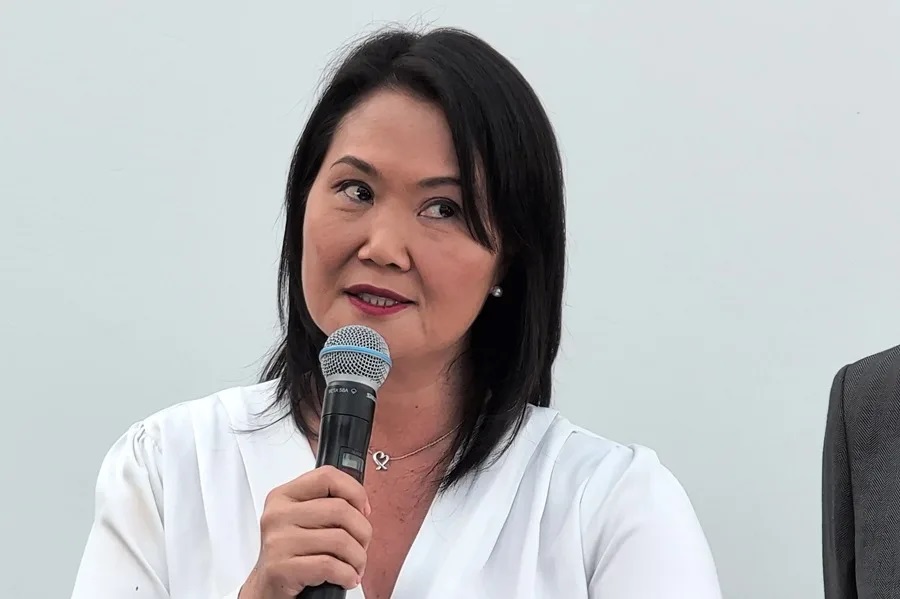
For years, the current president of Peru, Keiko Fujimori, served as first lady to her father, Alberto—a man who later became a dictator, reviled for his crimes. His political career had begun with center-left ideas, which helped him decisively defeat the right-wing candidate, the renowned writer Mario Vargas Llosa—a man with ties to the CIA who had once been a member of the Peruvian Communist Party.
Alberto Fujimori’s tenure began on a promising note; he even traveled to Cuba with Keiko to speak with Commander-in-Chief Fidel Castro regarding matters involving a specific guerrilla group. On that occasion, the young first lady embraced and kissed Fidel, expressing her admiration.
However, his desperate desire to retain power—surrounding himself with unscrupulous figures who ordered the execution of captured guerrillas, and orchestrating the forced surgical sterilization of over 3,000 Indigenous women—marked the downfall of a leader who eventually lost power and was sentenced to 25 years in prison. Since then, Keiko has attempted to rehabilitate her father’s image. She failed in her first three bids for the presidency, only to succeed on her fourth attempt—a controversial election in which she lost the domestic vote but was ultimately buoyed by the Peruvian diaspora and the suspicious handling of ballots sent from the United States, which were managed by the Foreign Ministry rather than the appropriate electoral authorities.
To curry favor with the "Empire," she made anti-communism her rallying cry, aligning herself with a bloc of right-wing, pro-Trump governments across the continent—a group dubbed the "Shield of the Americas." Their stated goal was to combat crime, drug trafficking, and other social ills—issues that these very leaders might do well to examine in a mirror first.
However, for Keiko’s more liberal-leaning approach, the ultimate test arrived when she found herself facing—and suffering setbacks at the hands of—a new Congress.
FROM YESTERDAY TO TODAY
For years, Keiko Fujimori leveraged her party’s power in the Peruvian Congress to corner the administrations of her political rivals. Now that she holds the presidency, the tables have turned.
Barely two months after taking office at the Government Palace, Fujimori has suffered a significant political setback this week. The full Chamber of Deputies ratified a drastic curtailment of the legislative powers she had requested to govern by decree. The leader of a party that once held an absolute majority in Parliament now commands only 41 of the 130 seats, leaving her dependent on the votes of other parliamentary blocs to pass her reforms. Her signature campaign promise—a "firm hand" against insecurity—now hinges on their support.
Her administration had requested authorization to legislate on matters of public security, the economy, and other areas for a period of 120 days. The proposal included 66 measures, but Congress pared that number down to 20 and shortened the timeframe to 90 days. Last Tuesday, the *Fujimori* faction attempted to regain some lost ground, negotiating with other parliamentary groups a proposal to increase the number of authorized measures from 20 to 29. The agreement fell through, and following a marathon 13-hour session, the Chamber of Deputies approved—with 66 votes in favor, 34 against, and 24 abstentions—the scaled-back version of the bill, which the executive branch had fought hard to alter.
Ultimately, 20 legislative powers were granted, focusing on public security and the response to the "coastal El Niño" weather phenomenon. Regarding security, these powers will allow the government to reinforce measures against extortion and organized crime, strengthen immigration and arms controls, and reform the prison system—though the Armed Forces were excluded from prison oversight, a key proposal put forward by Fujimori.
Some deputies opposed expanding these powers due to the security measures proposed by the government. "We could not give the *Fujimorists* a blank check to make decisions that might involve the Armed Forces and lead to human rights violations. There’s already a history with the *Fujimorists* on these matters," stated Fernando García Huby, a deputy for the centrist Good Government Party (*Partido del Buen Gobierno*). He was alluding to abuses committed during the administration of Alberto Fujimori in the 1990s—crimes for which the president’s father was later convicted.
The vote left Fujimori facing an unprecedented situation for her political faction. Although the *Fujimorists* constitute the largest force in the bicameral Congress, they lack a majority of its own in both chambers, and it lacks the automatic backing of the parliamentary groups it once considered allies.
“When they were in Congress, they had a sufficient majority—either on their own or through alliances—to subordinate the Executive branch. But they have never faced a scenario like this. It is as if they now don’t know how to navigate a situation where negotiation is mandatory,” argues Fernando Tuesta, a political scientist and professor at the Pontifical Catholic University.
RECENT HISTORY
In 2016, when the right-leaning liberal Pedro Pablo Kuczynski assumed the presidency, *Fuerza Popular* held 73 of the 130 seats in what was then a unicameral Congress. Although Fujimori was not a member of Congress herself, her parliamentary group censured the Minister of Education and, in September 2017, denied a vote of confidence to the entire cabinet, forcing it to resign en masse.
Later, even without an absolute majority, the *Fujimorist* movement maintained its power through alliances; during the presidency of the leftist Pedro Castillo, it supported the censure of five ministers. The power of Congress reached such an extreme that, over the last decade, the *Fujimorist* movement—either alone or in alliance with other parties—played a role in the removal of four presidents: Martín Vizcarra, Pedro Castillo, Dina Boluarte, and José Jerí.
Now that Fujimori is in power, securing votes has become one of her primary challenges. No one embodies this reversal of roles better than her Prime Minister, Luis Galarreta, who presided over Congress during part of the confrontation with Kuczynski. Back then, he was part of the party pressuring the Executive; today, he is the one tasked with negotiating on behalf of the President. For weeks, he met with representatives from various parties to advocate for 66 proposed measures, yet he failed to garner the necessary support.
Resistance emerged from among those who had appeared to be her allies. Renovación Popular, the far-right party led by Rafael López Aliaga, joined three other political groups to curtail the requested legislative powers. Negotiations on Tuesday the 6th ended in accusations of betrayal; Fujimorist lawmaker César Revilla claimed that another legislator withdrew his signature from a consensus proposal he had previously agreed to support.
Ultimately, the ruling party was forced to accept the same 20 measures that the government itself deemed insufficient—and they did not even do so as a unified bloc. With no other option, 34 of their 41 lawmakers voted in favor of the text they had sought to amend; without these votes, the measure would not have passed. The remaining seven abstained. “What was approved fails to provide the Executive with the most critical tools the country needs,” Galarreta stated in an official release from the Office of the Prime Minister.
Among the rejected powers were those that would have allowed for the expansion of intelligence operations and granted the Armed Forces a more direct role in securing prisons. Also excluded were measures designed to facilitate the formalization of small businesses and simplify administrative procedures. The government maintains that it required these authorities to combat the wave of extortion and contract killings plaguing the country, as well as to accelerate its reform agenda.
While the political left—aligned with the unjustly imprisoned former president Pedro Castillo—sought to reject the request entirely, other opposition groups agreed to grant limited powers. Some parliamentary blocs even split their votes.
This division could work to Fujimori’s advantage in the Senate, where her party holds 22 of the 60 seats. If she secures the support of the eight representatives from Renovación Popular, she would be just one vote shy of an absolute majority. The government intends to use this opportunity to attempt to recover some of the powers that were previously excluded. The president thus has a chance to regain some of what was lost—though doing so will require negotiating with parties that have already demonstrated they are unwilling to grant everything she requests. “If they don’t negotiate,” Tuesta warns, “what will happen is paralysis.”
Translated by Amilkal Labañino / CubaSí Translation Staff
Add new comment