
INFOGRAPHICS: US economic blockade against Cuba
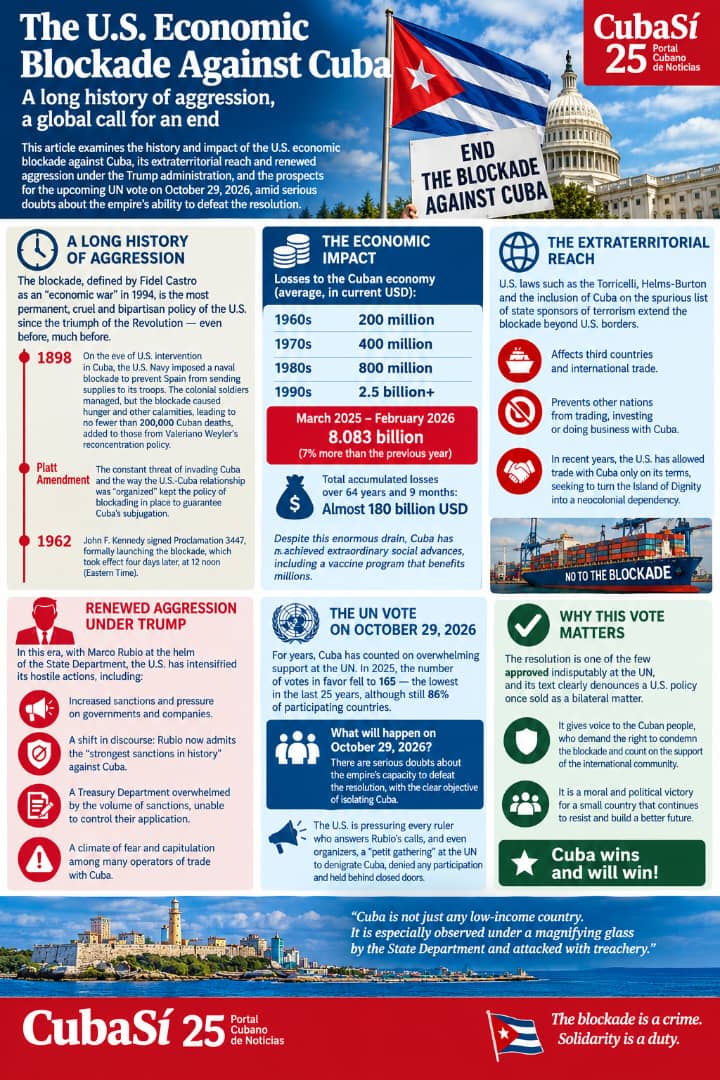
Cuba is currently facing the compounding consequences of an aggravated energy crisis and related hardships resulting from Washington's latest imperialist escalation.
The current strategy extends beyond the conventional embargo mechanisms under the Torricelli and Helms-Burton Acts. Instead, it relies on a technical and legal redesign engineered to suffocate the country through sophisticated mechanisms that are harder to challenge internationally while inflicting severe distress on the Cuban populace.
These measures affect Cuban families daily, particularly those caring for ill relatives who encounter severe transportation obstacles. Thousands of workers and students face daily transit disruptions, while healthcare workers navigate the operational pressures caused by electrical instability in hospitals.
Resource scarcity and energy restrictions have placed significant strain on Cuba's healthcare system. Surgical waiting lists reached 100,000 patients, including 12,000 children, while over 16,000 patients require radiation therapy and 2,888 depend on hemodialysis—services requiring continuous power supplies.
Although no conventional state of war exists between the United States and Cuba, the energy blockade and intensified sanctions represent violations of international law, human rights norms, and principles of international humanitarian law.
In response, Cuba has denounced the energy blockade before the United Nations as a form of collective punishment. On July 7, 2026, the UN General Assembly approved a procedural vote by 136-9 with 30 abstentions to hold an additional debate on the embargo.
Add new comment