
Fidel and Celia in the Memory of a Havana Child
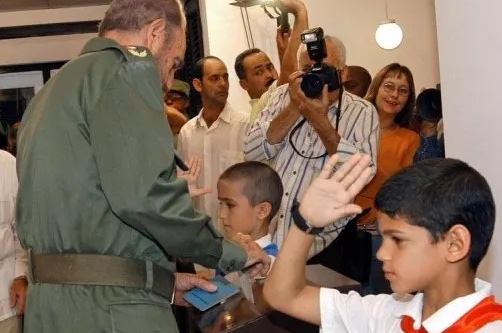
His name is Ignacio Turcios Lima Tamayo and he is no longer a child, however, when you ask him to tell you about his childhood on 11 Street in Vedado, he speaks in the present tense, as if to refer to his neighbors Fidel and Celia it were impossible to conjugate the verbs in the past, perhaps because the emotions of that childhood close to the leader are preserved intact in the man he is today:
“Having lived close to Celia Esther de los Desamparados Sánchez Manduley, it’s an honor, it’s a memory so intense that for me it is eternal, in the sense of not only being there, of having that space in history, but of directly receiving ideas, reflections, emotions, educational actions that have served me throughout my life.”
What impressions about Fidel and Celia do you have to this day?
“Growing up there, on 11th Street represents the privilege and emotion that, even when you are a pioneer, you have the attention of the Secretary of the Council of State, eternal heroine, the simple person who seeks in each of us to develop ideas, knowledge, improvement in the professional order, in the personal life.
“Being with Fidel and Celia is the energy that is transmitted in the universe, because the emotions are always very intense, and the voice in both of them, incredible, for us, Fidel, a magnificent speaker, but when he spoke with us it was something so simple, so warm, so close to one that stays with that emotion, the same was Celia, a very serene voice, very warm and with a permanent educational intention.
Any anecdotes from those years that are special to you?
"Among the anecdotes, many times, while we were there in the street, playing ball, when our colleagues from the garrison began to tell us: "Hey kids, come on, move aside, come on, get out of the street, and one looked in the distance on 11 Street when those K-69 vehicles were advancing, olive green. Even when the first vehicle, still away on the corner of 11 and 8 Street, before even reaching 10 Street, one could already see them there advancing and flashing the lights, the post that was located on the corner of 10 and 11 Street, removed the chain and assumed a position at the height of 10, that always caused a great impression on me, an emotion, because you are seeing the vehicle moving and they are jumping and occupying positions, then Fidel's descent was an event for us, despite being a fairly common image, every moment that occurred, the emotion of course it was extremely intense, that process is so interesting and so strong that it stays in your memory.
“When the Commander went to the Electoral College to exercise his right to vote, it was the eagerness of all the pioneers, eagerness is the best way to describe it, because we all wanted to be there at the ballot box at the moment he was casting his ballot, I never had that honor of being there, but I was among the team of pioneers, and I remember the neighbors who gathered outside, just the fact of seeing him walking to the Electoral College, it’s something that cannot be described, because Fidel gave away an energy, there was a karma around him that no matter how much one saw it every day, minute by minute, it was very intense. His gaze, which always travels around the entire place, and that looks at all of us who are there at that moment, always left that impression on us.”
At the moment, you are a specialist at the Fidel Castro Center. How much have those experiences influenced the researcher you are today?
“It’s important to be able to demonstrate, today, how much the influence of being there those years has been, to feel that energy, to feel the human sensitivity of Celia, caring for very humble people, the simplicity of Fidel, of always having a very intense love for the people, whatever their cultural level, their social origin, for Fidel and for Celia, it‘s something great to be able to listen to someone very humble, so one sees and feels those teachings, and today I follow the ideas with which the Commander worked day by day, about how to feel an inspiration in each person, each place where Fidel is, each vehicle that at any given moment he is using, is an inspiration, because today I feel Fidel's cars, all the vehicles that I saw there in the garrison, the first place was for work, several times I saw them arrive full of mud, obviously Fidel would come from a mountainous place, from a rural area, and that was something that caught my attention, and that is that Fidel's vehicles are for work and at the same time for combat, and it’s important to know that those same cars were for work, for combat, but also for study, because many times I saw him arrive and he was reading, and he would leave the book or documents when he got out.”
If you were asked to summarize Fidel's relationship with childhood in a few words, what would you say?
“I would say that he is a man of a lot of love, that we always see him as the magical elf who opens all the doors, then leaving a trace of love and joy wherever he walks.”
Translated by Amilkal Labañino / CubaSí Translation Staff
Add new comment