
Díaz-Canel in the "La Timba" Neighborhood: "Transformations Are Made with the People"
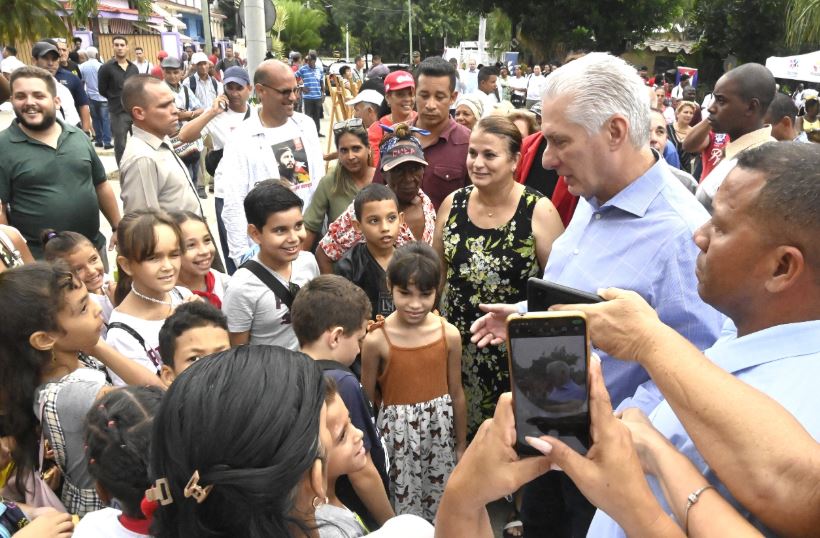
Efervescence, a multifaceted celebration, filled the La Timba neighborhood—belonging to the Vedado People's Council of the Plaza de la Revolución municipality—where the First Secretary of the Central Committee of the Communist Party of Cuba and President of the Republic, Miguel Díaz-Canel Bermúdez, arrived on Wednesday morning.
Accompanied by the first secretary of the Provincial Committee of the Communist Party in Havana, Liván Izquierdo Alonso; the capital's governor, Yanet Hernández Pérez; other authorities; and the residents of the neighborhood, Díaz-Canel toured several points marked by the activity driven by the "Mi Barrio por la Patria" movement.
Precisely "La Timba" is the name of a Local Development Project (PDL)—the first seen this Wednesday by the head of state—that produces food and has a marked social commitment: delivering bread and other supplies to a daycare center and nearby schools, in a community of about 5,000 residents.
There, among other ideas, the head of state spoke about the importance of "people participating, people contributing ideas," in a path that "helps address problems we must solve together." This—the president reflected—is a moment that makes one think about the neighborhood's key actors, granting them special prominence, while continuing to think about all the alliances that can be made to keep moving forward.
Olga Cubertier Gómez, president of the Vedado People's Council, held a dialogue with the Cuban President during the tour. She told him: "Today we have several activities planned," some of which, she said, had begun to take shape since last Sunday.
"Many of these activities the Council had been doing for some time, such as the Health Fair, which we are holding here again today." Olga recounted that health personnel visit the most vulnerable cases, together with social workers; and she also said that blood donations are part of this movement.
She referred to a neighborhood experience such as medicine donation, and spoke about how digital networks have been created that allow permanent communication among everyone, and that make it possible to "constantly receive the community's criteria."
Amid the cultural and sports activities taking place this Wednesday, Olga proudly stated that "the Council has the strength of counting on very good economic actors"; and in that statement she was recalling the value that alliances have today.
Key task today: understand and implement the transformations
At one point during his tour of the La Timba neighborhood, President Díaz-Canel expressed: "Here, now, there is a fundamental task that must also be done at the community level, which is the transformations. We already held a discussion with the Party membership; now we are analyzing what that discussion with the membership contributed—because there are new proposals to enrich the transformations, there are criticisms of the transformations, there is dissatisfaction, there is lack of understanding…"
The president added: "Now we are moving to a process with workers in the workplaces, and to a process with the people in the community." Regarding this last sphere of society, the head of state emphasized the need to "prepare well, to select well the people who in the community, together with the Committees for the Defense of the Revolution and the Federation, will explain things; because with that we complete a round, so that everyone understands the transformations, so that everyone also contributes; so that then, among all, we resolve the problems."
On the collective solution of problems, Díaz-Canel Bermúdez reasoned that "here there is no superior or supreme entity that is going to make the transformations: The transformations are made with the people. That is why the first thing is that we understand them, and then that we participate." Otherwise, he said, what is designed will not be achieved.
The benefits of "Mi Barrio por la Patria"
After conversing at the "La Timba" Local Development Project—whose creators have among their purposes paying retirees—the head of state headed to the SAF (Family Care System), not without first recalling a key word of these times: autonomy; and not without first speaking about popular participation, popular control, and a Municipal Assembly representing and discussing everything transcendent for the people.
On municipal autonomy, the president asked that "everything be in function of the economy plan and the territory's budget; and we must begin to make municipal budgets transparent, we must begin to make the budgets of social works in the municipalities transparent, so that the population also gives its opinion and knows. That way we control all processes."
Once at the SAF, Díaz-Canel continued conversing with leaders and with the people. And to an elderly woman who approached him with passion, he expressed: "Each time you must be attended to better. You are the people who did many things for the Revolution."
The Medical Consultation Office was another point on the itinerary. The neighborhood was full of girls, boys, and Cubans of all generations. More than once the head of state conversed with the little ones, and also with interlocutors who approached him with respect and affection.
"Greetings to all. And we must keep going," the president said in farewell. And once the visit concluded, the press team of the Presidency of the Republic of Cuba spoke with more than one protagonist of these hours.
Elíades Rodríguez Martínez, provincial coordinator of the Committees for the Defense of the Revolution in Havana, explained that La Timba's activity this Wednesday is part of the province's work system for the participatory process "Mi Barrio por la Patria."
He stressed that such a movement means that day by day "every Cuban, every revolutionary, every person of good will" does something for their country, and for themselves.
"What we are visualizing today," he said, "is not only for a visit: it is an everyday thing, which happens regularly." And he highlighted that "all the institutions of the province, the municipality, the People's Council, are in the neighborhood."
Misael Rodríguez Llánes, General Secretary of the Central Organization of Cuban Workers (CTC) at the capital level, recalled that one of the essences of the Cuban trade union movement is precisely bringing organization to the community.
Voluntary work is being carried out. Efforts are underway so that workers who are idle in their work collectives, for various reasons, form brigades and that these structures be—as Misael detailed—"the ones that can solve the neighborhood's problems," together with other organizations.
"Today, in this La Timba neighborhood, two union sections are being organized," announced the leader, who commented that one will be linked to solid waste collection, and the other will belong to the Local Development Project for food production.
For his part, Danhiz Díaz Pereira, secretary of the Young Communist League in Havana, stated that "this is an experience we have been implementing. In the summer it went very well," and that the fusion of youth with the "Mi Barrio por la Patria" movement offers "a work method that is becoming stabilized."
Regarding the Community Youth Network—that force full of vitality that has emerged in the territories—Danhiz recalled how they too are assisting those most in need: "Our projects in the neighborhood are strengthening the participation of young people in their community, in assisting the vulnerable, in helping the SAF…"
The young man is certain that, "in these very difficult times we are living in Cuba, we must continue promoting participation." In his opinion, "with the help of the mass organizations and the impetus that youth brings to these processes, without a doubt the result will be much better."
Add new comment