
Cuba: Neither Chinese nor Russian
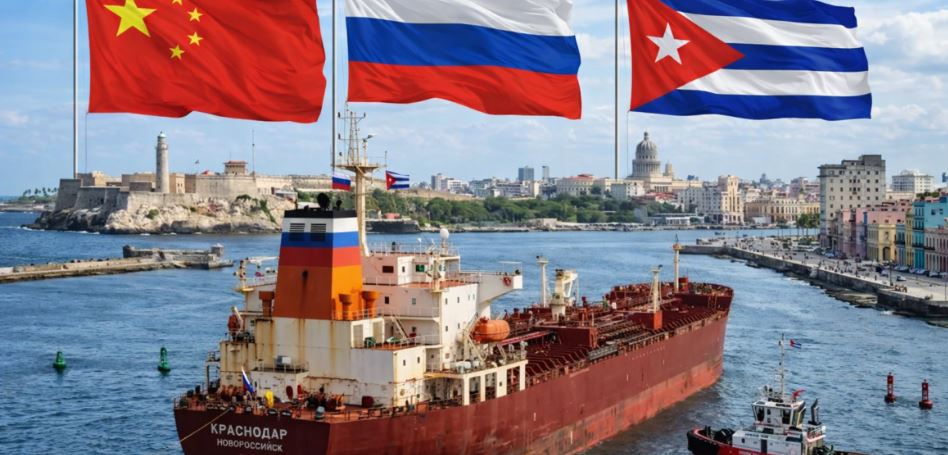
It’s a titanic task to refute the mendacious claims of the current Secretary of State of our northern neighbors, Mr. Marco Rubio García, or Mr. Rubio, invokes the supposed hostility of the People's Republic of China or the Russian Federation against the US as justification for the ongoing aggression against Cuba.
This is certainly nothing new; much less does it warrant the alarm expressed in the executive order of January 29, signed by Trump, in which Cuba was labeled an “unusual and extraordinary threat.”
The US, about to celebrate 250 years of independence, has been at war for no less than 200 years, mostly in actions abroad, especially since the system entered its imperialist phase. However, its leaders have always had to contend with what is called “isolationism,” that is, avoiding involvement in other countries and concentrating efforts on domestic issues.
This isolationism poses a serious problem for the system of wealth concentration and The American system, which has rested since at least World War II on the military-industrial complex, has now become a techno-military-industrial complex. This system is a classic example of how American transnational corporations are anti-American.
Therefore, enemies must be manufactured, invented, and someone blamed for the fact that, despite promises and the legitimate popular demand to "isolate" from the rest of the world and guarantee domestic well-being, it’s necessary to invade third parties. From this logic arose the Cold War and nuclear war, a panic generated by the only nation that has used two weapons, in Japan; also the war on terror, an invention, ironically, of the world's leading terrorists.
If we add to the above old doctrines like the Monroe Doctrine, now modified as the Donroe Doctrine (by Trump, as we know), then we have the "perfect" argument to turn extra-regional powers into villains, using this simplistic analysis, powers that in no way share the aggressive history of the US.
Then there are China and Russia, which, according to Washington, are forbidden from appearing in this part of the world. And anyone who supports their presence in the Americas automatically becomes an accomplice of these “enemies of the American people.”
As can be seen, this history spans at least as long as the Cuban Revolution, coinciding with the period of Cuba's relations with both China and the USSR/Russia. And these ties, entirely legitimate, adhering to international law and, of course, to the constitutions of Cuba and the aforementioned countries, have generated a kind of false or feigned paranoia in Washington.
As early as the Kennedy administration, the first alarms were raised when Cuba had to resort to and accept the generous aid of the USSR to confront the tremendous impact of the blockade, imposed from that time onward. From there, also based on international law, came the defense cooperation, essential in the face of growing imperial aggression.
When the Revolution was barely 20 months old, the US promoted—or rather, imposed—the so-called Declaration of San José, Costa Rica, an American invention to reinforce the anti-Soviet narrative, now with regional aspirations, aimed beyond American public opinion.
The Declaration states in its second paragraph: “…It also rejects the attempt by the Sino-Soviet powers to exploit the political, economic, or social situation of any American state, since such an attempt is likely to undermine continental unity and endanger the peace and security of the Hemisphere…”
And then, in a massive popular assembly, the Cuban people approved the First Declaration of Havana. On that occasion, the Commander-in-Chief read aloud to the roused crowd: [...] that the spontaneous assistance offered by the Soviet Union to Cuba, should our country be attacked by imperialist military forces, can never be considered an act of interference, but rather constitutes a clear act of solidarity…
Between 1965 and 1980, under the administrations of Johnson, Nixon, Ford, Carter, and Reagan, relations with the USSR continued to be the target of a media war and used as justification for threatening or attacking Cuba economically. Cuba's internationalist efforts in Africa were also touted as an example of the island's supposed satellite status with respect to the USSR, while Reagan labeled Cuba a hemispheric threat.
Later, when the USSR no longer existed, when Soviet communism had disappeared and everyone was happier, the Russian specter remained, fueled by the capricious narratives of US national security, and of course, Cuba, portrayed as a Russian henchman, accused of continuing their defensive collaboration.
How easy it would have been to resolve all this if the US had abandoned its aggressive and confrontational strategy against Cuba; but, well, that didn't align with the interests of the aforementioned military-industrial complex, those who hold power in Washington.
With the first and even more so with the second Trump administration, this myth not only persisted but adopted increasingly crude arguments, presenting ever more unbelievable lies, such as Russian responsibility for the fictional Havana Syndrome, which never existed, according to scientific evidence corroborated by the Americans themselves.
Also under Trump, since at least 2019, attacks against the People's Republic of China have intensified. Through some anti-Chinese narrative, China is accused of possessing a sophisticated telecommunications system and espionage bases—a colossal absurdity.
In this regard, China, unknowingly, actually has electronic intelligence facilities in Cuba near Florida, and that this station The wiretapping center, as it's called, also serves as a military training facility. Added to all of this is the "dangerous" Chinese expansion in telecommunications, energy, and transportation systems, now in 2026. And all of this is framed within the discourse that the Chinese presence in Cuba represents a "risk to hemispheric security."
On the other hand, the People's Republic of China has economic relations and ties with other nations bordering the US, and these are not considered an extraordinary threat. For example, Canada has a Chinese presence in sectors such as mining, clean energy, and stable bilateral trade; Mexico has ties in railroads, solar energy, and various manufacturing; the Bahamas has Chinese investments in ports, hotels, and industrial parks; and Bermuda has a presence in maritime logistics and insurance.
Frankly, using Cuba's friendship with China as a basis for attack is absolutely ridiculous; it doesn't even deserve serious attention. Because ultimately, the issue isn't even about Cuba. It's more global than that; indeed, the spectacular development of "communist" China—an absurd epithet used to denigrate it—represents formidable competition and an impressive example of how the world should operate, not with imperial bravado, but with a spirit and policies of cooperation, based on a win-win formula for all parties.
So therein lies the tremendous danger to the empire posed by China's existence. It's not just the obvious technological or industrial implications; it's the very conception of how international relations should be conducted in an era seemingly dominated by chaos. In short, China represents a world where the techno-military-industrial complex that dictates the fate of the US has no say.
In a few hours, President Trump will visit Beijing, and the world watches with anticipation, almost with anxiety, to see what will come of this trip, hoping that China's proverbial patience will somehow influence President Trump, that perhaps the confusion will enlighten the bewildered American leader on how to stop the bellicose atmosphere that has gripped the souls inhabiting the White House.
Cuba, of course, has much to thank the People's Republic of China, the Chinese communists, for this support during these very difficult and complex times that the Cuban nation faces is not only helping it survive, but also developing the island's economy, for example, the entire renewable energy program, to mention something so urgent for Cubans and for nature.
And, furthermore, there is an essential, non-negotiable aspect. Cuba has relations with whomever it wants, on whatever scale and in whatever areas it deems appropriate. And this is not a Cuban invention; it is what allows a nation to consider itself sovereign and independent. It's true, that doesn't give them the right to cover up aggressive intentions against third parties, but if anything is absurd, it's that the small island of Cuba can be a threat to the imperial hyperpower. This is neither unusual nor extraordinary.
In any case, the empire has only one option: to listen to its people, who demand isolationism, or whatever it's called now. The world is changing at lightning speed; multilateralism is no longer questioned, thanks to BRICS and its associates. And when Washington refuses to understand, well, there's Iran, where asymmetry reigns—if you understand the term—a situation that could easily be replicated in other regions. We'll see what happens.
Translated by Amilkal Labañino / CubaSí Translation Staff
Add new comment