
Cuba Approves Programs to Strengthen Social Protection and Employment Opportunities
HAVANA — The Ministry of Labor and Social Security (MTSS) presented new provisions that will allow the delivery of productive assets to people in situations of vulnerability, offer paid training to young people disconnected from study and work, and create Social Work departments in the provincial and municipal administrations of the People's Power.
The norms published in the Official Gazette of the Republic in its ordinary edition number 88, which will enter into force within the next seven days, include Decree-Law 136 On the Strengthening of Social Work and Decree 182 On the Creation of the Organizational Structure of the Social Work Departments of Provincial and Municipal Administrations.
Likewise, they stipulate Agreements 10455, the Economic Inclusion Program for the Provision of Small-Scale Productive Assets to Persons in Situations of Multidimensional Vulnerability, and 10463, which contemplates the Training and Preparation Program for the Labor Insertion of Young People Aged 18 to 30 Who Are Disconnected from Study and Work.
In this regard, Maily Morejón Concepción, director of the Social and Labor Observatory, explained that the initiative transcends the traditional approach of social assistance, centered on addressing immediate needs, and seeks to create conditions for people to develop economic activities and generate their own income.
The program is aimed at households in situations of vulnerability that have members able and willing to work, and who assume the commitment to comply with an economic inclusion plan.
Among the prioritized groups are caregivers, especially women with minors in their care and low incomes; young people aged 18 to 30 disconnected from study and work; persons with disabilities who can develop an economic activity; and those in informal employment.
Morejón Concepción specified that productive assets are grouped into three categories: agricultural and agroecological; destined for artisanal, transformation and service activities; and technological or digital support, and others that respond to the needs of each territory may also be incorporated.
For his part, Israel Antonio Riverón Sánchez, director of Employment at the MTSS, explained that applications are submitted at the municipal departments of Labor and Social Security, on the initiative of interested parties, through social workers or through employers.
Social workers carry out the characterization of individuals and families, whose results are evaluated by the social policy attention groups of the popular councils.
Subsequently, the Territorial Employment Management Service prepares, together with the possible beneficiary, an individualized plan that includes the person's capacities and skills, the economic activity to be developed, the necessary assets, the training and the implementation schedule, and it is submitted for evaluation and approval by the Municipal Administration Council.
Riverón Sánchez noted that financing may come from the state budget allocated to social assistance, the Social Protection Fund, the territorial contribution for local development, international cooperation, donations, bank microcredits and other authorized funds.
Paid Training for Disconnected Young People
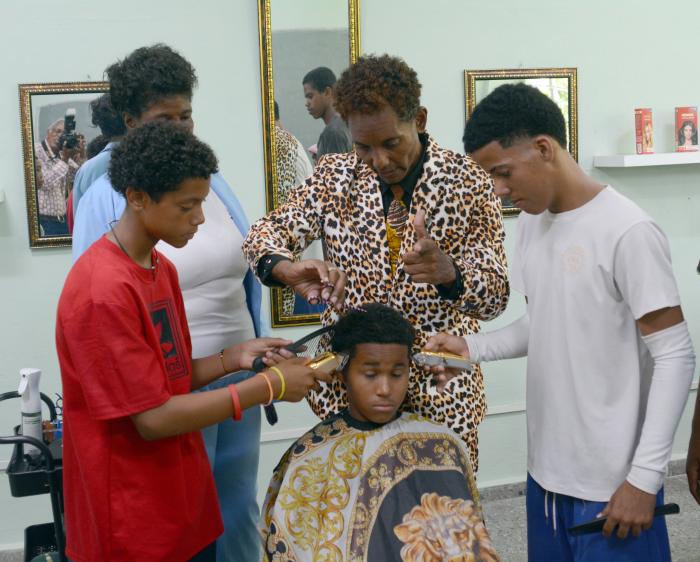
On the other hand, Agreement 10463 establishes a training and preparation program for the labor insertion of young people aged 18 to 30 who neither study nor work.
According to Riverón Sánchez, its objective is to facilitate the incorporation of these young people into productive and service activities through short courses that respond to the employment needs of the territories.
Exceptionally, adolescents from age 15 and before turning 18 may access the program, with prior justification of their situation of social risk, as well as persons aged 31 to 35 with family care responsibilities.
The program prioritizes residents in localities with youth disconnection, women with minors in their care and low incomes, persons with disabilities and young people facing barriers to accessing training or employment.
The courses will last from one to six months, with a minimum load of 20 teaching hours per week, and may cover trades in territorial demand, entrepreneurship, small business management and digital skills.
During the preparation period, beneficiaries will receive a monthly income equivalent to the current minimum wage, and in the case of young people in situations of vulnerability, financing will correspond to conditional social assistance benefits; for the remaining beneficiaries, it will be assumed by employing entities, in accordance with labor legislation.
To maintain that income, they must comply with at least 85 percent attendance at teaching activities and pass the evaluations of the training program.
New Structures to Strengthen Social Work
As part of these transformations, Decree-Law 136 establishes the bases for strengthening the social work system in the country, while Decree 182 regulates the creation and organization of Social Work departments of the provincial and municipal administrations of the People's Power.
Rita Machín Reyes, director of Social Work at the MTSS, explained that the Decree-Law, structured in four chapters, defines the concepts, principles, areas of action and articulation mechanisms of this activity.
The norm recognizes the intervention of social workers not only in communities, circumscriptions and popular councils, but also in educational institutions, hospitals, polyclinics and other social services.
It also establishes coordination mechanisms with agencies, institutions, and state and non-state entities, as well as a supervision system aimed at guaranteeing the quality of interventions and the professional development of these workers.
Machín Reyes highlighted that the new departments will be subordinate to the administrations of their respective territories, which will demand greater articulation with local governments and institutions linked to the prevention and attention of social problems.
The official insisted that the implementation of the provisions will require continuous preparation, professional ethics and active participation of social workers in identifying problems and seeking solutions.
Minister of Labor and Social Security Jesús Otamendiz Campos highlighted that the new transformations seek to strengthen social protection and help individuals and families in situations of vulnerability generate income through their own work.
He explained that social assistance must also be conceived as a process of transition toward economic autonomy, in which beneficiaries take advantage of their capacities and the opportunities existing in their localities to overcome the conditions that motivated their situation.
Likewise, he stressed the importance of rescuing the value of work as the main path to social protection and strengthening the professional preparation of social workers.
Add new comment