
Counter-critique: Onelio and the Flowers
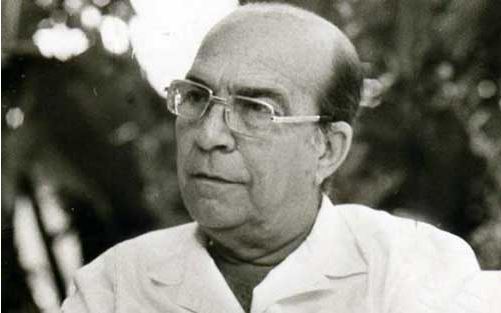
Onelio Jorge Cardoso taught us that man has two hungers. He wasn't referring only to the needs that are satisfied through economic means, but to that which defines us, to humanity.
His concept of fulfillment transcends the simplistic view some critics adopt. He is not merely a writer of creole writings; his themes extend beyond folklore. There’s a deeper meaning, a commitment that delves into the inner lives of individuals and doesn't dwell on trivial details. Onelio created his work on the periphery of the republic, though he did receive some recognition. His themes were not those favored by the bourgeoisie. They were considered stories dealing with poverty, uneducated speech, and the most humble segment of society. The truth is, when we read them, we feel the presence of ordinary people and their longings, sorrows, and demands. In stories like "Hunger," a whole artifice unfolds around a man who has died inexplicably but refuses to close his eyes. Physical hunger has transformed into a hunger of the spirit.
If anything distinguishes Cuban literature of the last century, it’s its dialogue with the avant-garde and with the nation's own history. This process unfolded in a conflictive manner, with leaps in which authors became entangled with macro issues, attempting to articulate a solution to the real-life drama through prose or poetry. Onelio does this, but from a different perspective. He doesn't confine his characters; instead, he exposes them, liberates them, and gives them the opportunity to defend themselves. Daily life doesn't emerge through the author's lens; rather, he scatters himself as much as possible. The result is the storyteller as a figure who permeates the entire work. This is a fictional creation, not necessarily an alter ego. Sometimes he embodies a character; other times he is the omniscient narrator who, nevertheless, remains close to the characters and follows them like a critical conscience, a kind of echo.
Onelio perfected his technique to the level of great masters. The short story was his territory, his lifeblood; with it he worked to bequeath a kind of different country, made from the scraps of memory and pain. It was the Cuba before 1959, the one he knew how to portray because he lived it and suffered through it. The Cuba of oblivion. His characters possess a rare hope, founded on the spiritual. They own almost nothing, they enjoy no privileges, yet they smile, they have life, they move forward in the void with a defiant gesture. Man has two hungers.
This thesis, kept throughout his work, gives an infallible framework to Onelio's narrative voice. His world is Calabazar, but it functions as a microcosm that unfolds with the eloquence of great poetics.
In one of his most memorable texts, called Old Iron, a peasant loses his son in the Second World War. His world collapses; only a plow remains in the middle of the land, the one the boy would have used upon his return. When Onelio addresses human suffering, he does so through symbols linked to work and creation, perhaps because he understood the plight of the working class better than anyone. The father refuses to donate the iron to the army because he understands that it will be melted down to make weapons that will kill sons like his own, even if they are on the other side. The brotherhood of the working class manifests itself in a subtle yet powerful way, without the need for a pamphlet.
As the country prepares to celebrate yet another book fair, a reflection on Onelio is essential. Not only because he embodies a kind of national conscience within the narrative, but also because his work, sometimes scattered, lacking adequate promotion and informed criticism, is often under-read. His prose, with all its existential weight, reveals more about Cuban identity than many treatises and meticulous research focused on facts. Onelio allows the reader to resonate, to connect with the soul of the Cuban people, and in doing so, to create a genealogy of the pleasure of reading that transcends the banal or mere self-indulgent exercise.
Therefore, approaching the characters of Calabazar de Sagua is to approach the heart of Cuba, the Cuba that continues to speak to us despite the distance and the many disagreements. In a present marked by the reconstruction of identities and the erosion wrought by technology, there’s a bright future for cultivating our own traditions. Onelio Jorge Cardoso is like wildflowers: he grows without rain, in oblivion, almost without soil. That persistence should be rewarded, above all with intellectual respect.
Translated by Amilkal Labañino / CubaSí Translation Staff
Add new comment