
 English
 Español
UN Reiterates Position Against US Blockade on Cuba
especiales

UN Spokesperson Reaffirms Call to End US Embargo Following New Executive Order
The Deputy Spokesperson for the UN Secretary-General, Farhan Aziz Haq, reiterated today the United Nations' position in favor of lifting the US blockade against Cuba.
"As you know, the General Assembly has repeatedly called for an end to the blockade against Cuba," the spokesperson stated in response to a question from Prensa Latina regarding the tightening of this policy, following the new executive order by the Donald Trump administration to unilaterally impose coercive tariffs on countries that sell oil to the Caribbean nation.
"We urge all Member States to comply with the resolutions of the General Assembly," he said.
Details of the New US Executive Order
An executive order published by the White House on January 29 and signed by the Republican president declares a "national emergency" regarding Cuba and, to address it, deemed it "necessary and appropriate" to establish a system of tariffs against countries that provide, "directly or indirectly," any type of petroleum to Cuba.
Context of Reversed Policy
Days before Trump's return to the White House last year, the UN confirmed to Prensa Latina that it "welcomed the announcement by the United States on January 14 regarding, among other measures, the removal of Cuba from the State Department's list of state sponsors of terrorism."
A late act by the outgoing administration of Joe Biden, but one that was in the right direction.
However, upon assuming office a week later, within his first hours in the executive mansion, Trump reversed Biden's decision with an executive order without presenting any new evidence and disregarding the work and assessment of his own state agencies.
Historical Background and UN Stance
Reactions were swift. UN Secretary-General António Guterres, at the time, even acknowledged that Cuba's conduct in some mediation processes, such as the peace process in Colombia, contradicted its inclusion on such a list.
Cuba was first included on that list of state sponsors of terrorism in 1982, during the administration of Republican Ronald Reagan, until Democratic President Barack Obama removed that designation in 2015, considering it lacked merit.
Illegality and Impact of the Blockade
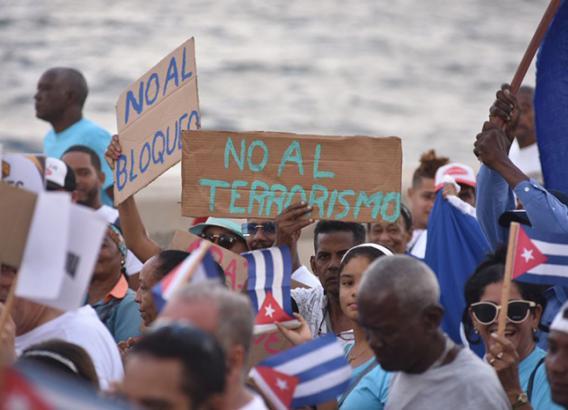
The economic, commercial, and financial blockade against Cuba constitutes a unilateral, coercive, and extraterritorial policy that violates International Law and the purposes and principles of the UN Charter.
After 65 years of application, its central objective has not changed: to deteriorate the population's standard of living, provoke dissatisfaction, despair, and irritation, as a means to induce a change in the constitutional order that the Cuban people have freely chosen.
The US administration persists in ignoring the nearly unanimous call of the international community to end this illegal and inhumane policy against Cuba, as expressed in 33 resolutions of the UN General Assembly.




Add new comment